
The Bremens

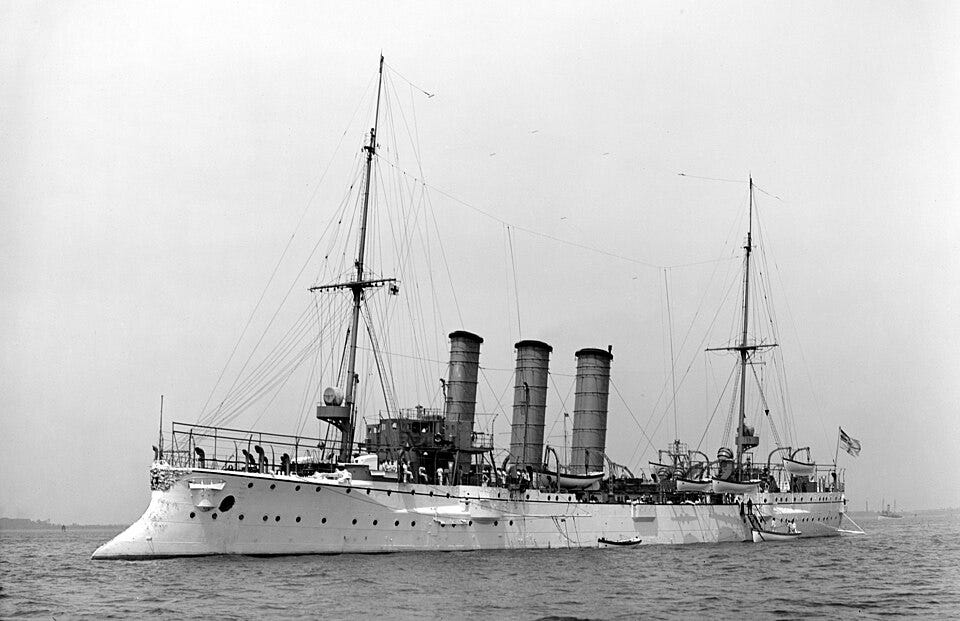
Regular readers might remember I wrote a piece on the history of the Gazelle class light cruisers of the Kaiserliche-Marine, Germany’s first light cruiser, though probably not as not many read it but…
If you didn’t and you want to its here.
In the same style of Disney movies giving you sequels you never wanted - here is part 2, the successor Bremen Class light cruiser.
The Bremen class was an evolution of the previous Gazelle class light cruiser and was designed to be a multi-mission based warship that could carryout patrols, escort, Kreuzerkrieg and fleet actions.
As a brief comparrison of stats;
The Bremens were an evolution of the previous Gazelle class but with an increase in size, speed, range and crew.
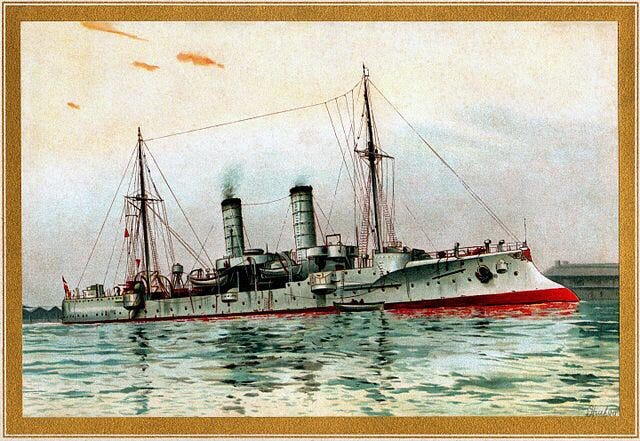
Gazelles displace 2643 tons
105m long
12.2m wide
4.8m draft
19.5 knot speed
3570 NMi range at 10knots
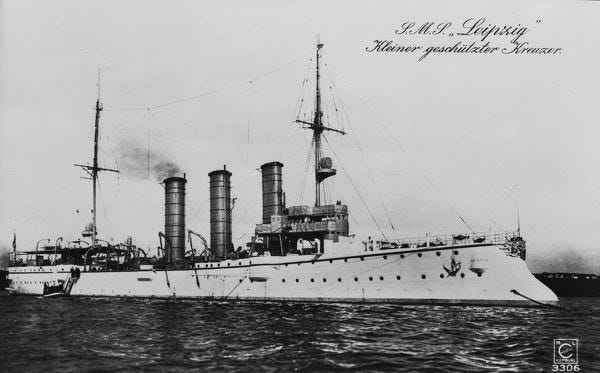
Bremen class displaced 3278 tons
111.1m long
13.3m wide
5.53m draft
22 knot speed
4270NMi range at 12 knots
She also carried two extra boilers.
Both classes carried 10 10.5 cm SK L/40 (SK - Schnelladekanone (fast loading cannon) in single mounts and two torpedo tubes with Bremen’s also sporting 10 maxim machine guns. However the Bremen had increased engine power and when Steam turbines were brought in in 1903 the power increased even further. The Bremens also sported the same ram bow that the Gazelles had as was the preference of the time which gives them a bit of an odd look.
They had a tendancy to roll in heavy weather, up to 20 degrees with Leipzig almost came a cropper off Cape Horn with excess coal stores in a storm in December ‘14. They were a touch wet at high speeds and a tendancy to turn into the wind but were manoeuvrable (though could lose 35% speed)
As part of the 1898 Naval acts Germany planned on building 2 light cruisers a year (increased to 3 in 1900) hoping to have thirty by 1904. The Cruisers were built between 1902-1907. Their careeers in the fleet were mostly with the High Seas fleet though Bremen and Leipzig did serve abroad on foreign stations.
So here come their careers:
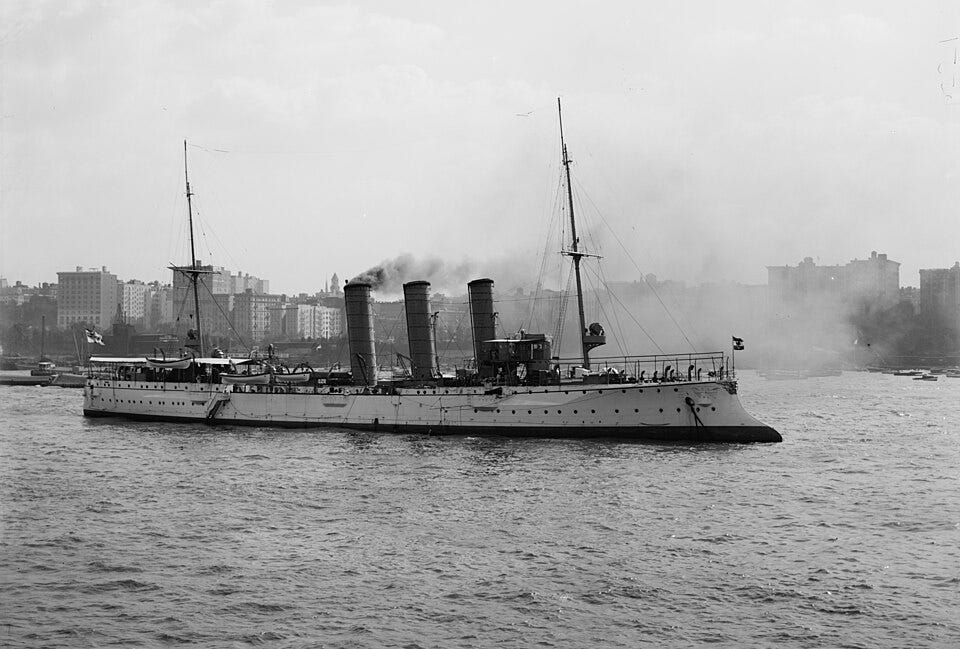
After commissioning in 1904, SMS Bremen was assigned to the America squadron and patrolled the Eastern seaboard of the Americas flying the flag for Germany and protecting German interests in areas of civil unrest. Then in March 1914 she was recalled to Germany. On arrival Bremen was decommissioned and put in for refit and four of her guns replaced with two 15cm guns. On completion in March ‘15 she was assigned to the Baltic where she bombarded Russian positions & took part in the Battle of Riga Gulf.
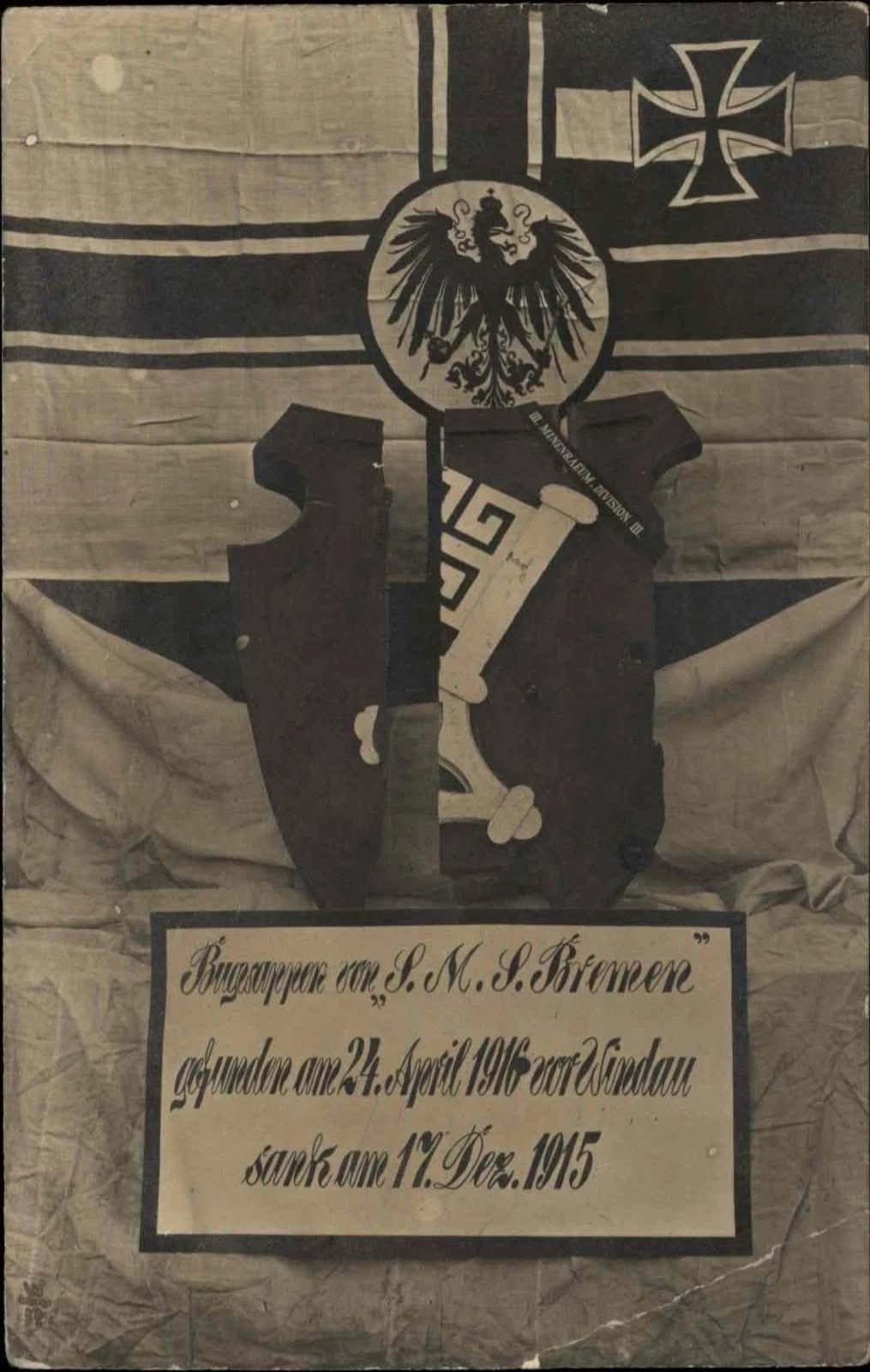
On 17th December 1915 whilst on patrol one of her escorting torpedo boats, V-191, struck a mine. Bremen moved to assist but struck two more mines and sank with 250 men killed with only 53 saved by V-186. Her last duty had been as part of a mine sweeping force and in the above photo this was added on a tallyband to the damaged bow ornament which was brough up from the wreck as a memorial.
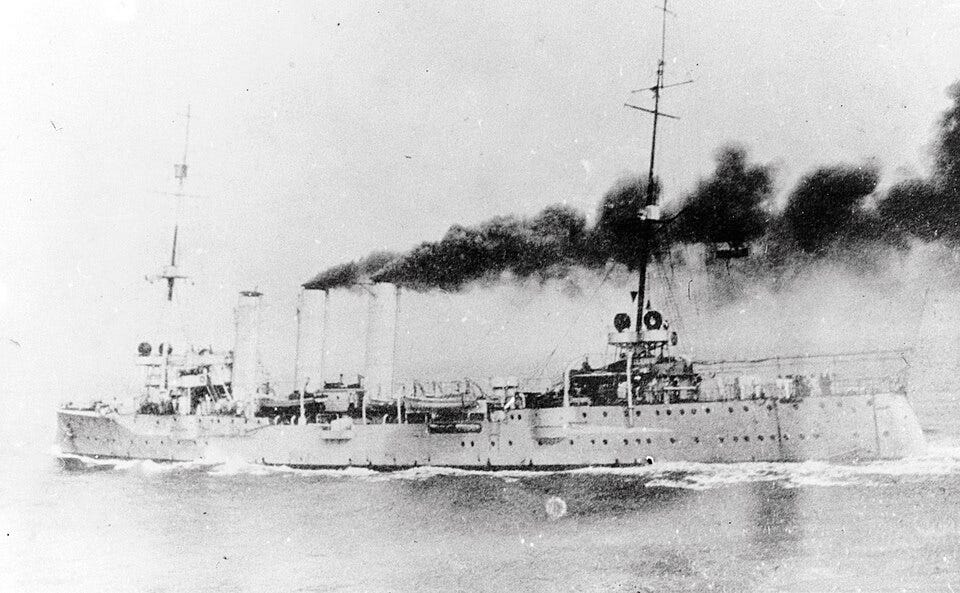
After commissioning the Hamburg served with the fleet reconnaissance force and provided escort for the Kaiser’s yacht Hohenzollern. Herman Bauer served as Captain aboard her in 1913-14 before he transferred to the U-boat arm and would later write a book on the design & utilisation of U-boats.
During the First World War she became a flagship for a flotilla of U-boats but also took part in sorties into the North Sea including the raids on Scarborough, Lowestoft and Yarmouth. She was at Jutland and was damaged during the night action losing fourteen men in the battle.
Due to relative obsolescence Hamburg was reduced to a HQ ship following the action of 19 August 1916. Post war she passed into the Reichsmarine and was recommissioned later coming under fire from Soviet gun positions at Kola Bay in 1921. She would also be used to quell civil unrest in Hamburg, serve as a training ship, be commanded by Erich Raeder (future Großadmiral), go on a world cruise before being converted to an accommodation ship & finally scrapped by the Kriegsmarine in July ‘44.
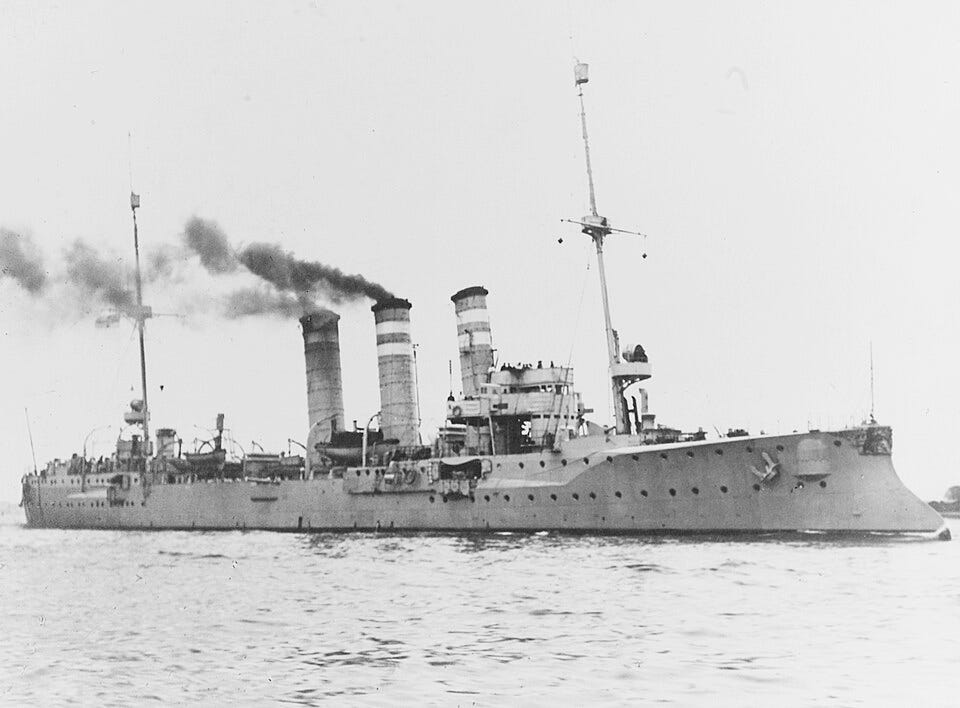
The Berlin served with the High Seas Fleet after her commissioning as part of the reconaissance force. In 1911 she took part in the Agadir crisis having been sent to relieve the gunboat Panther. It was decided to keep Panther off the coast (later relieved by her sister Eber) but supported by the Berlin at a distance.
Having been demobilised pre-War she was remobilised in 1914 & joined the IV Scouting Group spending most of her time in the German Bight. She transferred to II scouting group & escorted mine laying missions into the North Sea & had to tow her sister Danzig after she hit a mine. Later fitted to carry mines, Berlin was transfered to the Baltic where she, yet again, had to tow Danzig after another mine strike. As the Baltic fleet was cut back the Berlin returned to the Bight patrol. She was attacked by HMS E38 but survived but had to tow her damaged sister München.
Similarly she survived into the Reichsmarine, was modernised, removing the ram bow amongst other things, went on the first major naval cruise post war, was used as a training ship for cadets and eventually placed in reserve. In ‘47 she was scuttled with a hull full of chemical weapons for disposal.
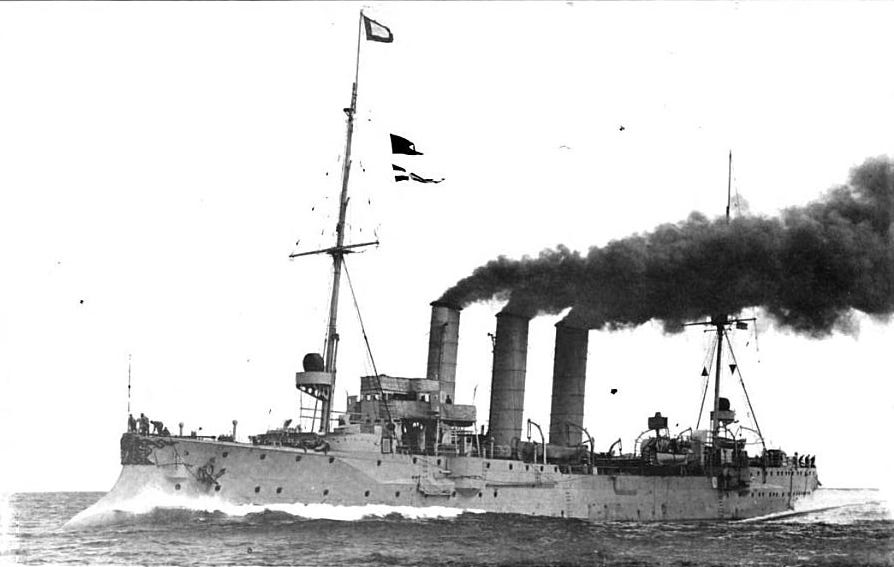
The Lubeck’s trials showed that her turbines were not providing enough power & engineers looked at possible redesign work but in 1905 she was sent to St Petersburg with an escort of Torpedo boats to rescue Nicholas II should the 1905 revolt get really unstable. Lubeck would take part in fleet manoeuvres and operations until 1909 when she was assigned to back up the gun boat Loreley during unrest in Turkey. She was placed in reserve between 1911 & 1914.
Lubeck was assigned to coastal defence in 1914 before moving into the Baltic where she became flagship of Komodore Johannes von Karpf and took part in the shelling of Libau and in Konteradmiral Hopman’s major assault on the city on 7th May 1915.She struck took part in the Battle of Åland Islands scoring hits on the Russian cruiser Rurik, the Battle of Riga gulf, escaped torpedoing by Russian sub Gepard, HMS E8, but struck a mine in 1916 severely damaging her. She was repaired & refitted but could not be commissioned due crew shortages. She became a U-boat training school but after Versailles ceded to the UK and scrapped in 1922.
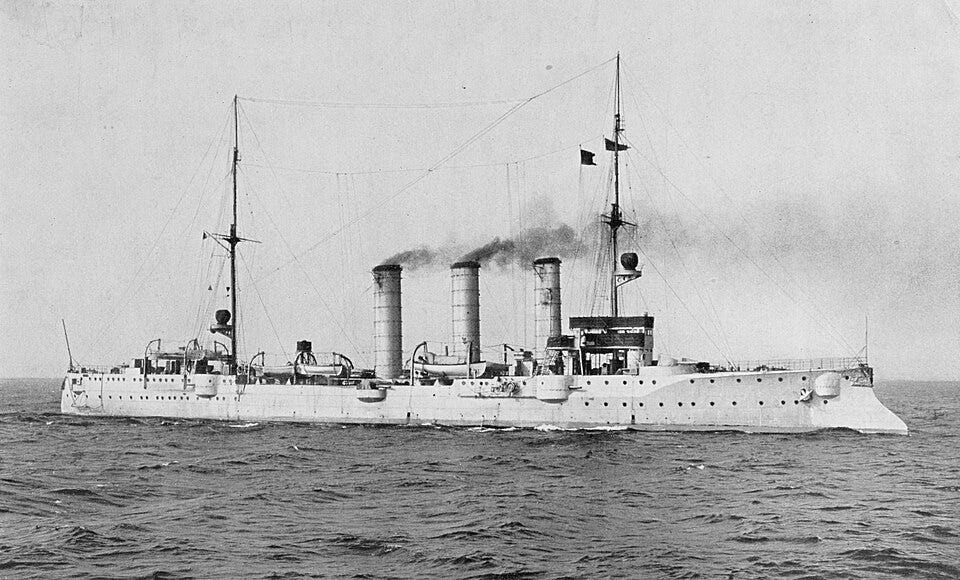
SMS Danzig was used in the Reconnaissance force before becoming a gunnery training vessel. In 1914 she and Münchcen rescued the crew of the Ariadne during the first battle of Heligoland Bight and refused Hipper’s orders to concentrate on Von der Tann as they were rescuing crew. Like her sister Berlin she moved to the Baltic & took part in operations against Libau. In later operations she struck a mine on 25 November 1915 and had to be towed. She later took part in the battles of Moon and Osel islands. She was scrapped post war.
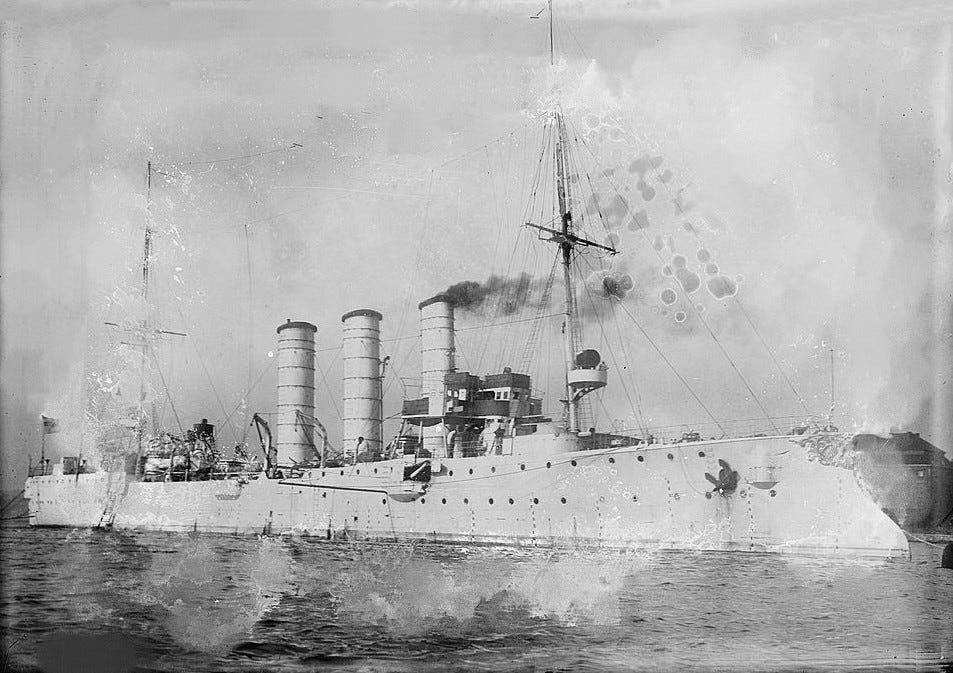
SMS Munchen was commissioned into the Navy on 10 January 1906 and carried out trial voyages in the Baltic until the 30 March where she was moved to replace the Nymphe as a test ship for torpedoes and for wireless telegraphy as well as training cruises. Following the Russo-Japanese War the European navies had been given a lot to think about and Munchen was used in shooting trials to run through these lessons as well as other training roles.
In 1907 the Kaiser came aboard to watch the U-1 which was carrying out a trial attack on the cruiser to show what this new fangled U-boat could do in combat.
In 1910 she was involved in a collision with the torpedo boat S-122 who tried to pass in front of her during fleet excercises. The ram bow cut into the S-122’s engine room killing two but both ships were taken to port.
The Kaiser with Tirpitz, Ingenohl and von Muller came aboard for the fleet excercises 1913 but would also be involved in another collision with a torpedo boat, this time V-159.
As tje First World War began the Munchen was assigned to the III Scouting Group but later relegated to the IV Scouting Group before heading to the Baltic with Danzig. Both vessels were recalled and were present at the Heligoland action but on the periphery.
Within Munchen’s role in the Scouting Group she took part in the actions against Yarmouth, Scarborough and a relief force to Dogger Bank in January 1915. In May the IV Group proceeded to the Baltic to carry out actions off Libau and in the summer they moved back to the North Sea to search for British ships. She was involved in another collision, this time the freighter Moskau badly damaging the cruiser which had to be dry docked.
She served under von Reuter at Jutland and was involved in the thick of the fighting and almost collided with the Frauenlob as she was sinking following torpedo strikes from Southampton. She also suffered damage to her range finders and a wheel shaft in the helm which left the crew steering from the steering gear compartment. During the battle she had fired 161 rounds and had four men killed and twenty wounded.
The cruiser also took part in the August sweep of Dogger Bank and the October one which saw her being hit by a torpedo from the submarine HMS E38 causing her to ship 500 metric tons of water and the sea water contaminated the water in the boilers. The damage was too bad with the Navy deciding the best thing they could do was to decommission the ship as a warship and reduce her to accomodation ship for patrol ship crews. Post Versailles she was assigned to Britain as a War prize and sunk as a torpedo target in the Firth of Forth.
The attentive readers might notice there is a missing vessel, the Leipzig. Now the Leipzig is one of my favourite German cruisers - a sentence that shows why I am still single. I’ve spent quite a bit of time writing about her time with the Ostasiengeschwader and sinking at the Falklands in December 1914 but if you want to read more here’s her career between August and October 1914.
If you enjoyed this breakdown of the class’s ships and careers and want me to do another one, whether German, French, British or Austrian then let me know in the comments.
Battle of Åland Islands is also known as Battle of Gotland as the action apparently was somewhere between Gotland and Åland. Info about the battle may be easier to find if searching for "Battle of Gotland" as the Åland islands saw action also in 1918 and earlier in 19th century during the Crimean war.
Also a minor typo (or probably actually autoincorrect), schnelladekanone might be better translated as "fast loading cannon" than "fast life adding cannon". Though loading obviously adds life to cannons, they are very quiet otherwise.