
Germany's first light cruiser
The Gazelle class

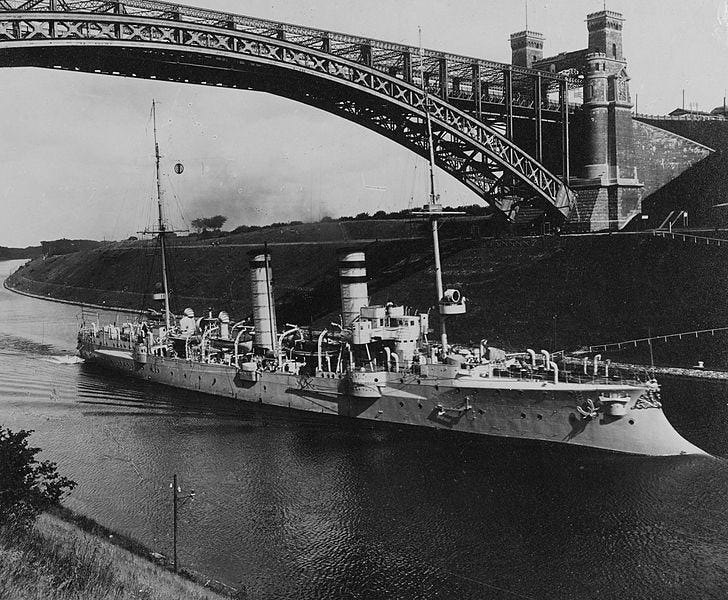
The German Navy, much like the other world navies, was constantly evolving through the late nineteenth and early twentieth century to meet new challenges and make better warships for the fleet.
Towards the end of the nineteenth century the German fleet was made up of older screw corvettes, Avisos for fleet scouting and unprotected and protected cruisers. What the battlefleet needed was a force for scouting and screening as well as a force of ships that could now serve as a police force for the Island holdings in the Pacific and for the Schutztruppe in Africa and was the idea of Captain (later Admiral) Alfred Tirpitz, but it was an idea that the Naval Command and Technical department ran with and the Gazelle class would answer this issue.
Firstly, what were they replacing?
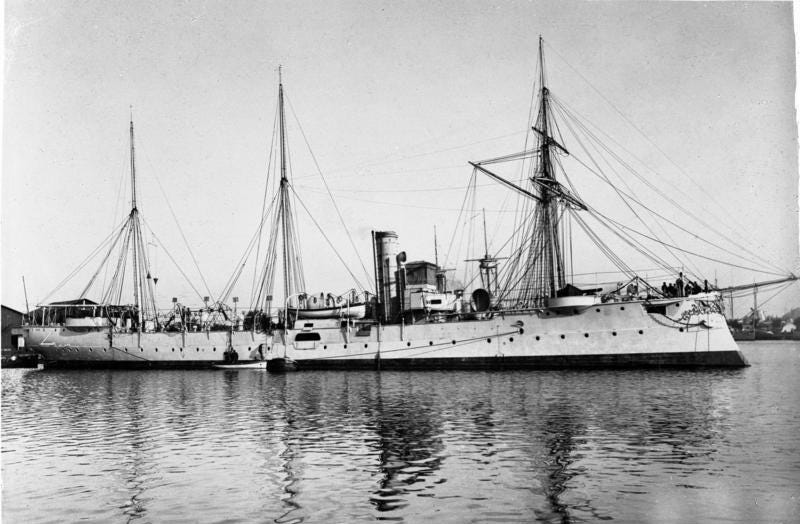
The Bussard class unprotected cruiser evolved from the Schwalbe class and were larger but with the same amount of fire power (Eight 10.5 cm guns, 5 revolver cannon and two torpedo tubes) and all six were produced between 1888-1893. All six vessels were posted to the colonies, either Africa or Far East, The Bussards were capable vessels for the policing roles but only had a speed of 15 knots and a range of 2990 nautical miles if they stuck to 9 knots meaning that they were not very useful for fleet scouting and their lack of armour made them very vulnerable to enemy guns. They were also the last class of cruiser to carry a sailing rig.
The Reichsmarineamt looked at proposals for a new class on 10th May 1895 under the designation “G” and the final decision followed Tirpitz’s suggestion though with a smaller calibre of guns to keep the displacement down. The proposed top speed of 19.5 knots made it faster than all of the current battleships by three knots which made them perfect as scouts for the fleet. Alfred Dietrich, the Kaiserlicher-Marine’s chief designer, began work on the Gazelle project between 1895-6. As more sisters were added to the class between 1897-1900 improvements and additions were made to the original SMS Gazelle.
One such improvement was that as the second was being proposed for the 1898 Naval budget was to increase the speed to be even faster than the new Kaiser Friedrich III class battleships which could reach 18 knots. What the RMA wanted was a cruiser that could reach 21 knots. They also looked at increasing the calibre of the guns but Dietrich argued that to add both of these improvements would not only increase the displacement over the demanded “not more than 3000 tons” but also increase the cost by 25% which the Reichstag would likely reject. Instead new improvements in the engine machinery by the Germaniawerft shipyard gained the extra three knots taking the Niobe a top speed of 21.5 knots.
Talking of engines the Gazelle was fitted with two triple expansion engines built at the shipyard and could produce 6000 HP whilst the Niobe and all of the subsequent class this was increased to 8000 HP to give them the extra three knots. The engines were fed by eight boilers in two boiler rooms but the amount of coal carried by the cruisers varied from ship to ship.
Gazelle, Niobe and Nymph carried 500 tons (a range of 3570 miles at 10 knots)
Thetis, Ariadne, Amazone and Medusa carried 560 tons (which gives a range of 3560 miles at 12 knots)
Frauenlob, Arcona and Undine carried 700 tons (which gave a range of 4400 miles at 12 knots).
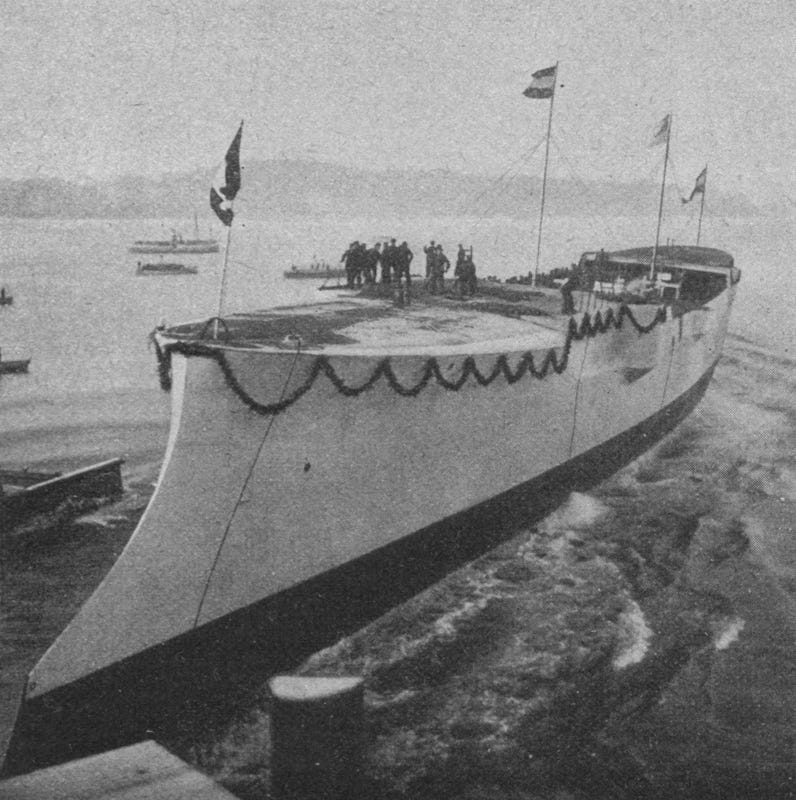
After commissioning the Gazelles were used for fleet reconnaissance though some did see foreign station duties briefly with both Gazelle and Thetis being assigned to the East American station and the Caribbean station and were present during the Venezuelan crisis. The Niobe served with the East Asian Squadron between 1906-9 but on her return it was found her engines were very badly worn from the three years abroad without proper maintenance. The Undine was used as a test bed for dealing with torpedo boat attacks following the Russo-Japanese War of 1904-5 which had shown the West that these vessels were really quite deadly!
By the First World War though these vessels were nearing obsolescence but were mobilised for service though most were used for defending ports and coastal areas in the Baltic and far away from the main fleet - except for Ariadne (which was sunk during the first battle of Heligoland Bight in August 1914) and Frauenlob (which was lost at Jutland having attracted a lot of attention from the Royal Navy!) however this was not a safe haven and in November 1915 the Undine was sunk by Francis Cromie’s E-17.
There were seven remaining Gazelles were disarmed as their guns and crews could be used more productively elsewhere except for the Medusa which held on to six of her guns as a training vessel attached to the venerable Konig Wilhelm which was serving out her last years as a training barracks and the Thetis which was refitted with nine 10.5 cm U-boat deck guns so that she could be used to train U-boat crewmen in gunnery.
The Gazelle was the only vessel not to survive the treaty of Versailles period and was scrapped in 1920 but the others would go on to serve in the post war Reichsmarine as they were already obsolete compared to the Royal Navy’s light cruisers. However by the 1930s they were pretty far from cutting edge and the new Kriegsmarine wanted to look at more modern ships. The elderly Nymphe and Thetis were scrapped and the Arcona, Medusa and Amazone were relegated to barracks hulks and the former two were later adapted to flak defence ships.
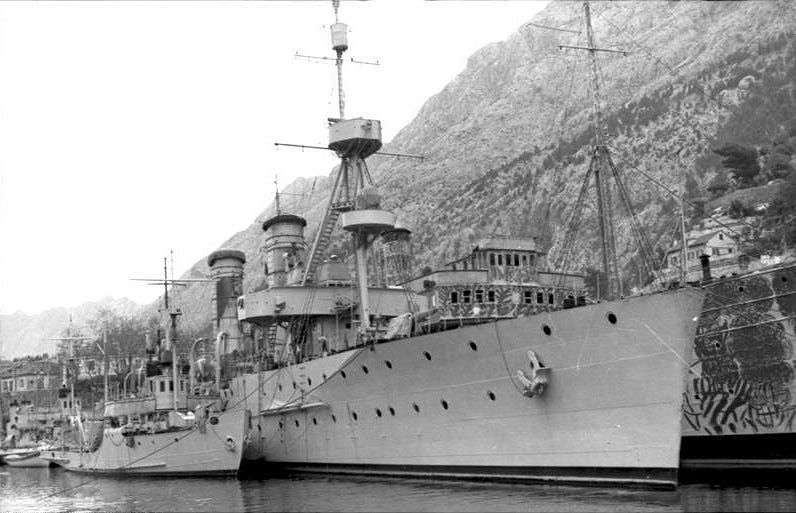
The Niobe was sold to Yugoslavia as the Dalmacija in 1926. She was delivered disarmed (Germany couldn’t export armed vessels) and without her conning tower. The vessel arrived on the 3rd September 1927 at the Yugoslavian yard at Tivat and rebuilt as a training cruiser with shortened masts and funnels, a crow’s nest on the foreast. New guns were fitted in the form of six skoda 8.5 cm quick firing guns and four 2 cm guns for anti aircraft though this seems like it is under debate by Naval historians so…
She entered service as a gunnery training ship and cruised the Mediterranean a few times before the Second World War started. With the German invasion the Dalmacija attacked the Luftwaffe’s bombers when they engaged the 1st Destroyer Division. She was also earmarked for an attack on the Italian positions at Zara, Dalmatia, to provide anti-aircraft fire. With the collapse of Yugoslavia the plan was scrapped and the vessel fell into Axis hands on the 25th April with the Italians taking possession of the now named, Cattaro, and used as a gunboat and gunnery training ship, a submarine target ship as well as for torpedo bombers, and in studies for wireless guided torpedoes.
With Italy's surrender she was moved to the Independent State of Croatia’s navy and then back to the Kriegsmarine and was renamed Niobe. By this point she was armed with six 8.4 cm, four 47mm, four 20 mm Oerlikon and twenty-six Breda 20 mm anti-aircraft guns - so was pretty formidable. With this large amount of anti-aircraft fire she was assigned to escort Adriatic convoys including moving the 71st Infantry division to the islands of Cres, Krk and Lussino as part of Operation Herbstgewitter.
On the 19th December Niobe ran aground on the island of Silba due to a navigational error and tugboats were requested to assist her but she was wedged firmly. Three days later two Motor torpedo boats (MTB 276 and MTB 298) attacked the stricken Geran vessel sinking the tug Parenzo and heavily damaging Niobe. The Germans abandoned the wreck and set about damaging equipment and guns as well as canablised by partisans for parts once the Germans had gone. She would finally be broken up in 1952 and was the second to last of the Gazelles to be stricken after the Arcona was scrapped in 1948, Medusa scuttled in 1945.
The last of Germany’s first light cruisers was the Amazone which had served as the U-boat school barracks in Kiel as well as being attached to the Warship Construction Test Office. She went on to Bremen post war and was an accommodation ship for German refugees who had fled the east before laying unused and unwanted from 1951-4 when she was scrapped.