
Shot on the Quaterdeck
Admiral Byng and the battle of Minorca

Naval history has many a hero and villain, a genius and dunce but occasionally there is a victim of circumstance. The story of Admiral John Byng is one of those.
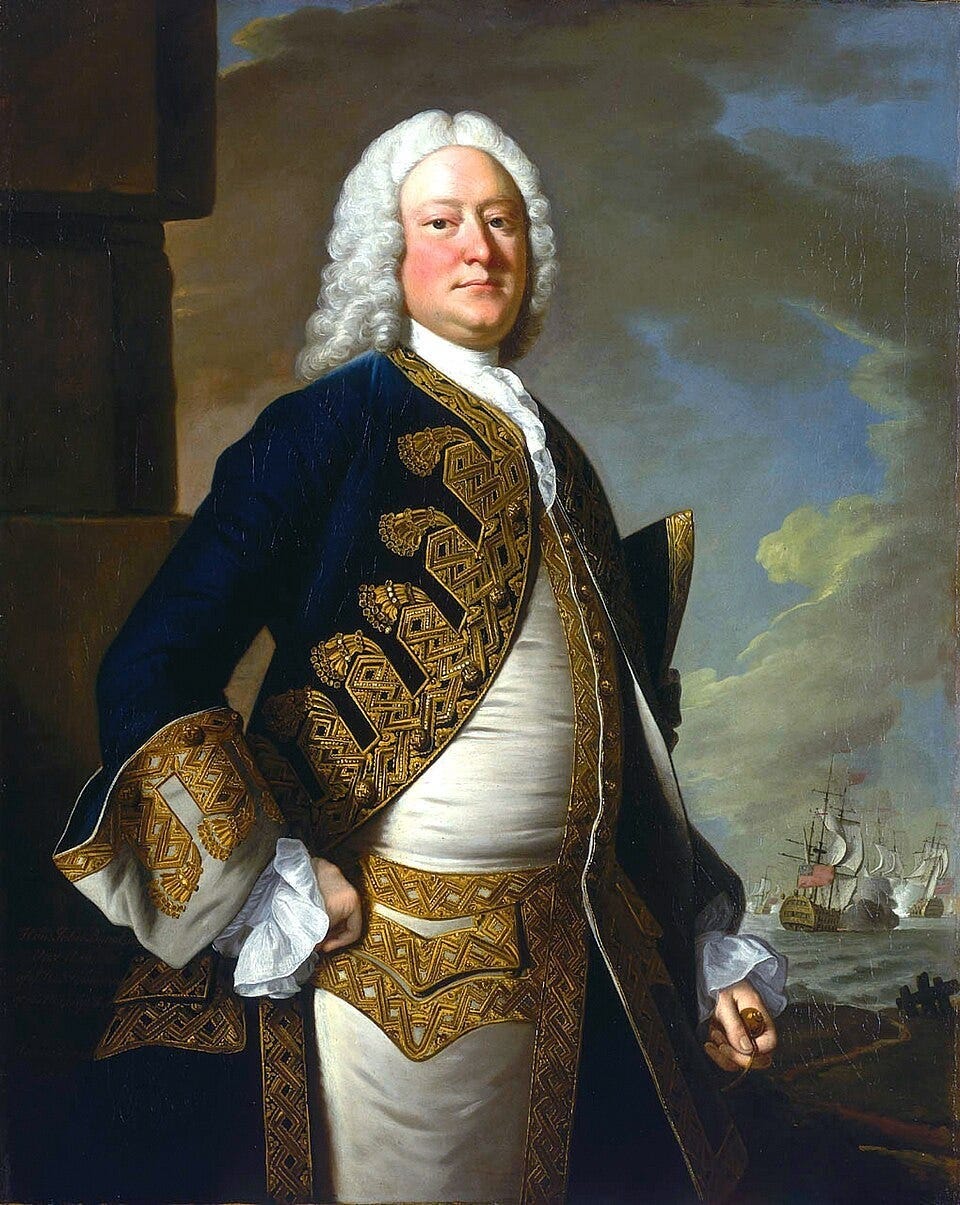
John Byng was born in 1704 to Admiral George Byng, 1st Viscount Torrington, victor of the Battle of Cape Passaro and his wife Margaret. John was one of fifteen children but only one of six to survive their father.
Although his naval career was quite distinguished, having served in the Mediterranean and becoming Captain of the sixth rate HMS Gibraltar at the age of twenty-three and Rear Admiral at the age of forty-one, Governor of Newfoundland and Commander-in-Chief at Leith where he severed the supply lines of the Pretender Charles Stuart during his campaign to claim the throne.
As a reward for his ability and his role in the Jacobite rebellion he was promoted to Vice Admiral and Commander in Chief of the Mediterranean Fleet whilst serving as a Member of Parliament for the City of Rochester upon Medway from 1751.
This may be a quick skim over his career but that is because he is only remembered for one thing and one thing only, the Battle of Minorca in 1756.
The Island had fallen into British hands in 1706 following the War of Spanish Succession but it remained a jewel the French and Spanish would like in their Crowns whilst British diplomats warned the Admiralty that it would be a target in a future conflict - especially from a French fleet being drawn together in Toulon with the London Evening Post reporting that in 1755 there were twelve Men-O-War being fitted out in the French port.
Surely the Royal Navy would dispatch warships to defend the islands and repel the French?
Well you’d think so but as per usual the British always cut military numbers post War and then find themselves massively under prepared for the next War - its what we do.
Britain had all of three Ships of the line in the Mediterranean squadron in 1755 with Sir George Anson, head of the Admiralty, prioritising the defence of the Home Islands from a possible French invasion and keeping the majority of the best ships back.
Byng was told to organise a squadron to go to the region on 11 March 1756 but found that the six ships he could gain in Portsmouth were undermanned, in disrepair with masts and equipment missing or just missing completely and his budget to repair and provision his vessels was slashed. To make matters worse, resources were being given to the Channel Fleet further delaying Byng’s departure by a month.
In April, he put to sea using Fusiliers from Colonel Bertie’s regiment as sailors due to shortages.
The orders given to Byng were to engage and decimate (the superior) French Toulon fleet and then relieve the garrison at Minorca, two feats that he could not hope to do, especially that the French landed a force of 15,000 troops on the Island. Byng found out the state of play when he arrived in Gibraltar with news that a regiment of Marines were to be given to him to help reinforce the Garrison, or at least that was the order from the War Office.
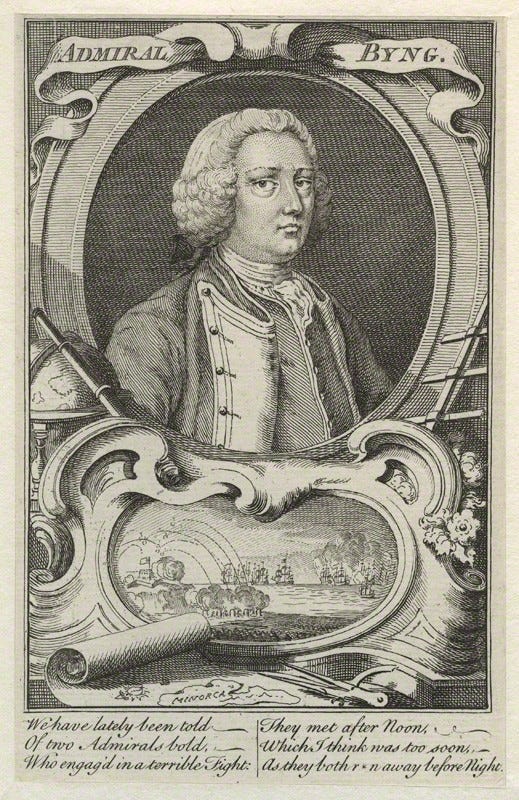
However, General Fowke, the garrison commander at Gibraltar refused to give the troops. Byng hoped to repair and resupply his ships but found the Gibraltan dockyards were in a sorrowful state and unable to meet his needs and Byng was forced to continue his mission and set sail. He did, however, write a dispatch to the Admiralty saying that in his opinion the Garrison could not hold out against the French and that without Marines he could not relieve them or reinforce them - even if he landed his Fusilier crewmen, which would leave his ships massively undermanned. It was really looking like a disaster waiting to happen and Byng wanted to put it on record that he was being dealt a dud hand and was still attempting to play it.
On arrival off the Garrison at Fort St Phillip the British ships attempted to signal the Fort but had not managed it by the time the French fleet reacted to his presence and Roland Michel Barin de La Galissoniere moved to engage.
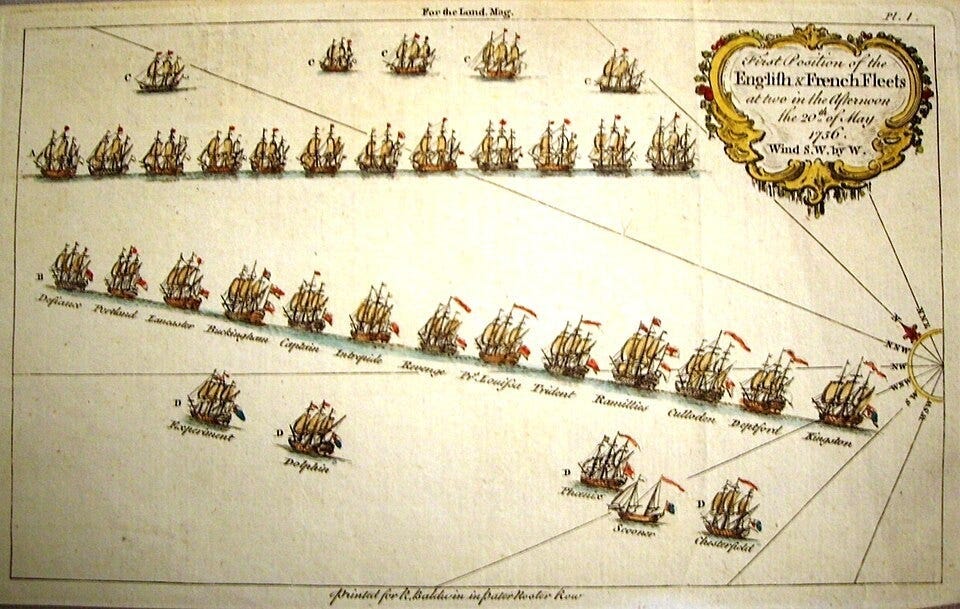
Byng now had thirteen ships, having recovered ships from the Minorca squadron that had escaped from the French attack and now had a roughly comparably sized force of twelve ships of the line and seven frigates against twelve ships of the lines and five frigates though the French force was in a better condition than Byngs.
… and with more men….
On the morning of 20 May the two forces engaged with Byng getting the weather gauge and began to lead his ships in a line towards the head of the French formation so that they could begin the bombardment but there was some signalling mishap and the British line did not form up quickly.
Due to this the lead ships of the formation, who arrived first, took a lot of damage whilst the British tail, including Byng, came up from the rear. The Intrepid suffered three masts destroyed and started sinking but instead of passing her to continue the battle the rest of the vanguard held position to keep the battle line and it took a considerable time for Revenge, the second ship in the line, to overtake her.
The line was broken and Byng had to take almost half an hour to reform itself, whilst the French pulled away from them. The French also maintained their battle line and although the Maquis de la Galissoniere was very cautious, Byng was even more cautious and his under armed and manned ships suffered at the hands of the better prepared French force. Captain Gardiner, the flag Captain, believed they could pursue the French and catch them but Byng declined citing Admiral Matthews who had been dismissed for doing that at Toulon in 1744.
The British had lost forty five killed and 162 wounded to the French 38 killed and 184 wounded in the engagement.
Byng stayed off Minorca, somewhat ineffectually and not being engaged (or engaging) the French. As things were not going well, but not disastrously he held a brief Council of War as to what to do and whether his officers felt they had a chance.
They felt that they didn’t and withdrawal was seen to be the best course of action. They could neither relieve the garrison, repel the French army or break the French ships, much better to preserve the force and come back. They set course for Gibraltar in the hope of getting more ships, marines and repairs.
They arrived on the 19 June and gained four more ships of the line and a frigate and they began resupply and repair work. Before they could sail again another ship arrived and relieved Byng and Fowke were recalled and on their return Byng was placed into custody.
On 29 June, the garrison at Fort Phillip were forced to surrender to the French.
The defeat at Minorca was a defeat at the end of a long line of defeats and cockups that had faced Britain so far in the War including the destruction of Braddock’s Command at Mongongahela in 1755, problems in India and the fall of Calcutta as well as issues at home including food riots and serious questions about the Duke of Newcastle’s premiership. Someone needed to be a scapegoat and the Admiralty were damn certain it was not going to be them.
Clearly Byng had failed to follow his orders to the letter and had not relieved the garrison or done enough to repel the French. It had nothing to do with the French being better prepared or the Admiralty cuts to the Mediterranean command. They even heavily edited his report for the London Gazette taking out parts that alluded to blame elsewhere and reworded other parts to give the opinion that Byng had fled as a coward.
Basically, it was a stitch up.
Understandably there was a public outcry against the hapless Admiral and he found himself at his court-martial onboard HMS St George in Portsmouth, charged with breaching the Articles of War and not doing the utmost against the enemy with the punishment being death.
After four weeks Admiral Thomas Smith, Rear Admirals Holburne, Norris and Broderick acquitted Byng of personal cowardice but they said that during the battle his ship was too far out of range and that he had not done his utmost to engage or destroy the French force.
By breaking this 12th Article he could only be sentenced to death but the Admirals suggested to the Admiralty that they should petition the King to waive it and be merciful. The Lord COmmissioner of the Admiralty, John Forbes, refused to sign the death warrant calling it an illegal order and affixed an affidavit explaining why he refused.
First Lord of the Admiralty, Richard Grenville-Temple, requested an audience with the King to beg for clemency but the audience was refused. The judges got permission from Parliament to break their oaths of secrecy so they could speak on Byng’s behalf but the Lords voted against it
Pitt the Elder, Secretary of State for the Southern Department was able to speak up but couldn’t due to political complications and his own argument with the King over whether to relinquish his position as Elector of Hannover meant that when he did submit an appeal it was dismissed.
Suspicion was rising that it was the Admiralty covering its own back and blaming Byng and both the Navy and the Common folk came out in support of the accused. Pitt, as Leader of the House of Commons petitioned the King again stating that the House was in favour of clemency.
You have taught me to look for the sense of my people elsewhere than in the House of Commons. - King George II
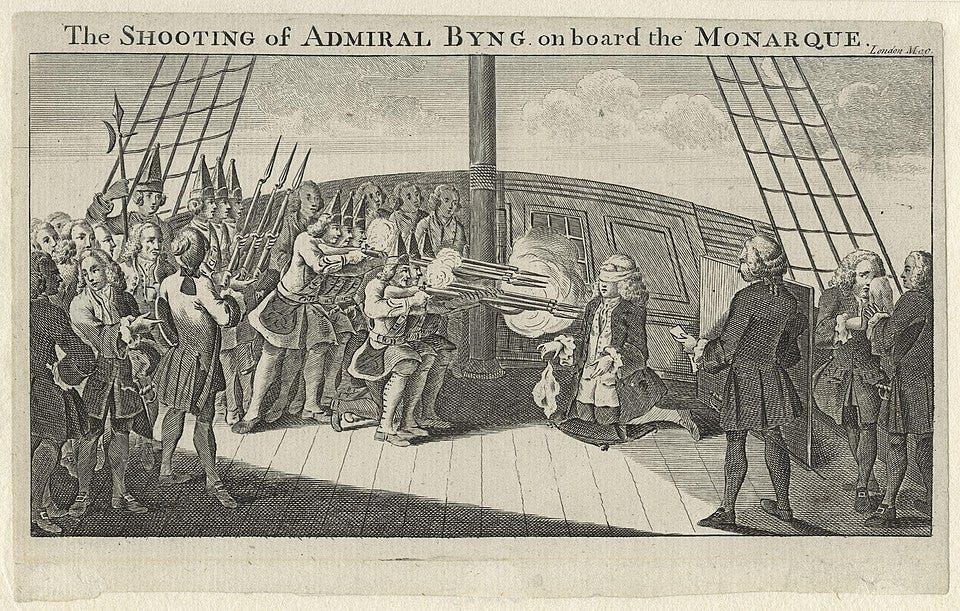
On the 14 March 1757, Byng was brought on to the quarterdeck of HMS Monarch in the Solent, before the ship’s company and spectators on smaller boats nearby. He knelt on a cushion and raised a handkerchief as a signal to the Marines present to ready their arms.
He dropped it and they fired.
His epitaph reads;
To the perpetual Disgrace
of PUBLICK JUSTICE
The Honble. JOHN BYNG Esqr
Admiral of the Blue
Fell a MARTYR to
POLITICAL PERSECUTION
March 14th in the year 1757 when
BRAVERY and LOYALTY
were Insufficient Securities
For the
Life and Honour of a NAVAL OFFICER
The Maquis de la Galissoniere did not fare much better, despite his moderate success being celebrated in France and rumour has it a Marshal’s baton was readyed for presentation to him by King Louis XV, he died of an illness before the confirmation of the award aged just 63.
Byng’s descendants petitioned the Ministry of Defence in 2007 for a pardon and were refused.
So did he deserve the punishment he got?
In my opinion, no, he was a scapegoat.
The government had neglected the command and region, failed to provide him with the tools to do the job and the French had out fought him. The only thing he could do was return for more ships and men whilst the island fell. Ultimately the island was returned to British control after the War in exchange for French territories that had been captured so his death was for nothing.
It would echo through history though for any Royal Navy officer who “did not do their utmost” and drive some to make less than wise decisions lest they end up like Byng. It was even a consideration when Admiral Troubridge paused and allowed the battle-cruiser Goeben escape in 1914. Had he done his utmost?
Overall it is an unfortunate story of a man sent to do a job with inadequate tools and getting the blame for not being able to do it.
Not the Royal Navy#s most proud hour.