
Writing on the wall?
Moving to the Second Phase 25 February - 1 March in the Dardanelles

With the relative success of the action of the 25th February and the neutralisation of the outer forts the way was set for the Allied fleet to start moving up the Dardanelles Straits to deal with the minefields and Admiral Carden had the forces to carry this out with a flotilla of pre-Dreadnought battleships.
The next phase would be to take out the forts in the Dardanos group that covered the minefields with Fort Dardanos as the lynchpin of the Asiatic side defence, it sat 800 feet above sea level and was believed to mount two 5.9” guns but these had been reinforced by three more guns from the Messudieh which had been sunk by HMS B-11 on 13 December 1914. The aged ironclad was only being used as a guardship at this point and, in a way, she would continue to do so with her 10 and 7” guns being added to the fort and also to form the Battery Messudieh on the European side reinforced with thirty-three field guns and light naval guns. Another battery, White Cliff battery, had been dug out and reinforced but had no guns whereas another four batteries had been hurriedly established after the attack of 19 February.
The plan was simple with one battleship moving up each side of the Straits firing on the defences as far as Kephez Point and would have howitzers on deck to provide fire against field guns. In front of the battleships min-sweepers would start their sweeping so that the way would be set for the future operations against the middle forts.
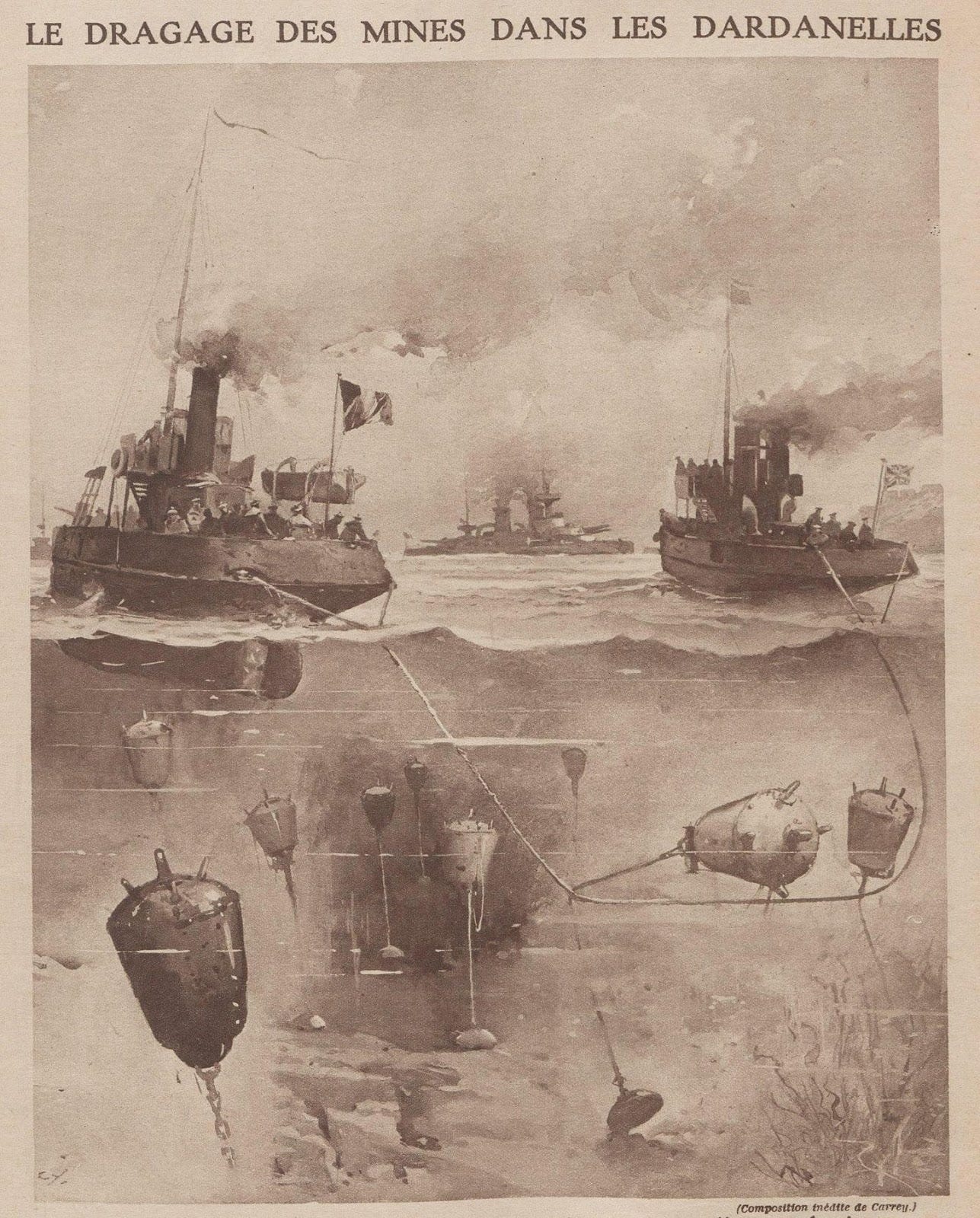
I should really pause and describe the minesweepers as these are not warships with naval crews rather commandeered fishing trawlers with their civilian crews. They would deploy their nets and trawl until they could pull a mine up to the surface and it could be defused or detonated. It was far from ideal but it was what was available at the time and was the reason for the previous raids to silence the forts to make it safe for the civilians to proceed. The night of the 25 February saw a group of trawlers head up the straits under cover of night and escorted by destroyers to begin the job of clearing the path for the warships. They managed to get four miles up the Straits and declared the area mine free for the morrow.
The whole operation on 26 February was also to be supported by seaplanes who would provide spotting information to the two warships, Albion and Triumph who were to be supported by the Majestic carrying a howitzer on each of their two turrets.
The obvious priorities were the forts of Sedd el Bahr and Kumkale which would need to be destroyed completely whilst Albion would shell a torpedo station and observation point at De Tott’s battery and Majestic to hit the bridge with her 6” guns over the Mendere River cutting the road between Chanak and Kumkale - an action the elderly warship carried out without any return fire and as the Triumph and Albion began their approach between 10-11:00 a.m. reaching the limit of the swept area with Albion attacking the north shore and Majestic the south with both firing at extreme range with the former firing at 12,000 yards at Dardanos and the latter at a field battery near the In Tepe Mound.
At 9 a.m. “Action” was sounded, and away went to quarters; being a signalman, my place was on deck by the flags. The mine-sweepers, led the way until we reached the entrance of the Straits, and then we took over the lead, ploughing our way proudly up the narrow channel.
What a triumph for the Majestic to be the first ship to enter the Straits; at her age too! At 9:15 we opened fire on the bridge with 6-inch shells, and soon had the thing scattered to oblivion. It was then we discovered a party of Turkish troops round about the ruins of the forts. Poor Devils! - a few shrapnel shells literally blew them off the earth. The few that escaped scuttled like rabbits among the broken masonry and general wreckage. - Petty Officer Cowie HMS Majestic
As the battleships fired their heavy guns the escorting destroyers ran closer to shore to try and locate any positions of field guns or howitzers in the countryside and also to sink any of the buoys being used by the Ottomans for ranging their guns.
The Ottomans had been silent for most of the day but at 3:00 p.m. howitzers and field guns opened up from somewhere out in the brush, possibly from a hill south-west of Eren Keui but none of the spotters, nor airmen, could see the guns or report their positions.
This was yet another problem that would become a big problem for the Navy in its prosecution of its campaign in the Dardanelles, the first being the inability to destroy guns unless they got a direct hit and the battleship’s inability to destroy the earth works. The new one of the field guns and howitzers was even more ruinous as these guns were moved about, even during actions, which meant the battleships could not easily strike them nor see them. Their deployment had been started in November after the first raid by the Royal Navy which had so rashly been ordered by the First Lord of the Admiralty and giving the Ottoman’s fore warning of a future weakness and twenty mobile 6” howitzers were on the peninsula by the end of 1914 at Eren Keui and twelve more on the opposite side in the hills near Fort Messudieh with four more joining them and twenty four mortars. Not only would they provide a danger for ships they would force them to keep moving and unlikely to stop to sweep for mines and maybe even be forced onto the minefields.
The gun fire from these positions started to cause problems for the Albion and Majestic who had to keep mobile to avoid getting hit which made their accuracy poorer and saw both ships struck, including a below the waterline strike on the Majestic and at 4:00 p.m. de Robeck ordered the recall.
We proceeded slowly up the Straits, opening fire on various places that might possibly conceal troops or batteries. For a time we did as we liked, but as we made progress we gradually came under fire from Turkish batteries. Now and again would come a flash from behind the hill and then the dull “woof” of the shell as it struck the land behind us or exploded on contact with the sea. Sometimes the impact with the water was not enough to detonate the shell- - dependent upon the style of fuse mechanism, I suppose - and all that happened was a sudden perpendicular jet of water. The real excitement came when the first enemy shell found its target, and the old ship quivered with the explosion. That ought to have been sufficient to keep every one below except those whose duty compelled them to remain on deck, but it had precisely the opposite effect. Every man who was not on duty scampered up to see the “fun”; most of them seemed to regard it as a kind of regatta, and the captain repeatedly had to order them below. But still they creapt up, filled with an insatiable curiosity. - Petty Officer Cowie HMS Majestic
Outside the straits de Robeck had been busy engaging a field battery near Yeni Shehr and the Dublin had also engaged in searches near Yeni Keui and sighted Ottoman forces withdrawing from Kumkale as the Majestic bombarded the forts there. An abandoned field gun position was sighted and had the Marines been present in number a landing force could have disabled them easily but no one had thought of this as a possible outcome for the day so they were sat back at Tenedos.
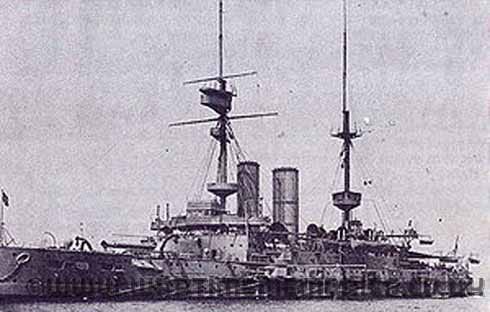
Though de Robeck didn’t have large numbers of Marines he did feel there were enough aboard his ships to carry out the landings and requested permission from Carden for the landings whilst preparing to send men from the Irresistible to hit the European side whilst Vengeance struck Kumkale whilst Cornwallis, Dublin and destroyers Racoon and Basilisk joined the two battleships in covering the landings.
Major Heriot RMLI led a force of fifty marines from the Vengeance with a demolition force under Lieutenant Commander Robinson RN with instructions to take out the guns at Kumkale and push up to Orkanie battery as well as the anti-aircraft guns nearby and make sure the bridge at the Mendere River that Majestic had shelled was actually destroyed. They would have protection from the light cruiser Dublin which took up position at Yeni Shehr and the Vengeance moved up to Kumkale.
After the initial landing, at 2:30 p.m., the Marines were able to push up through Kumkale to the cemetery without any resistance where they came under fire and it looked like a force of Ottoman infantry were going to launch a counter attack from Yeni Shehr. The Marines were forced to take cover in a hollow observing that the enemy seemed to be around the windmills on a ridge near Yedi Sehr. The Dublin began a barrage with lyddite shells that levelled the windmills in three minutes.
An attempted flank to the Mendere River failed with several men being injured and falling back to Heriot’s position which was also under cross fire from the river and the cemetery behind them. There was no way they were going to reach the battery at Orkanie now but Robinson believed he got to the guns nearby at “Achilles’ Tomb” and was given permission to try. They managed to get half way but weren’t sure where they were and so Robinson decided to press on alone, under sniper fire and wearing a white uniform that stood out, with some gun cotton and scout the way, he soon found the anti-aircraft guns and destroyed one of them with the explosives he had and went back to his men to get some more.
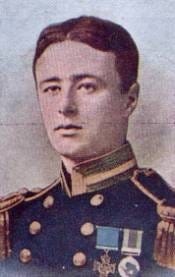
On reaching his detachment they were able to watch the Dublin pound the Ottoman positions and decided to press on together where they not only found and destroyed the remaining anti-aircraft gun but also pushed on to Orkanie battery taking out the only gun carriage there. After Robinson’s men withdrew in good order he was also able to direct accurate fire on Ottoman positions from the fleet.
The King has been graciously pleased to approve of the grant of the Victoria Cross to Lieutenant-Commander (now Commander) Eric Gascoigne Robinson, R.N., for the conspicuous act of bravery specified below.
Lieutenant-Commander Robinson on the 26th February advanced alone, under heavy fire, into an enemy’s gun position, which might well have been occupied, and destroying a four-inch gun,[18] returned to his party for another charge with which the second gun was destroyed. Lieutenant-Commander Robinson would not allow members of his demolition party to accompany him as their white uniforms rendered them very conspicuous. Lieutenant-Commander Robinson took part in four attacks on the minefields – always under heavy fire. - The citation from the London Gazette for Robinson’s VC.
In the meantime Heriot had signalled the Vengeance that things were going south quickly and de Robeck ordered the recall to ships and the Marines fell back through the cemetery under sniper fire but with no further casualties beyond two wounded and Sergeant Ernest Turnbull who had been killed.
The forty five men of the Irresistible were led by Captain H B N Panton RMLI had also landed safely on the European side of the Strait and advanced to the windmills and established a picket line near the windmills and in the ruins of an old castle whilst the thirty strong demolition teams worked their magic in four sections.
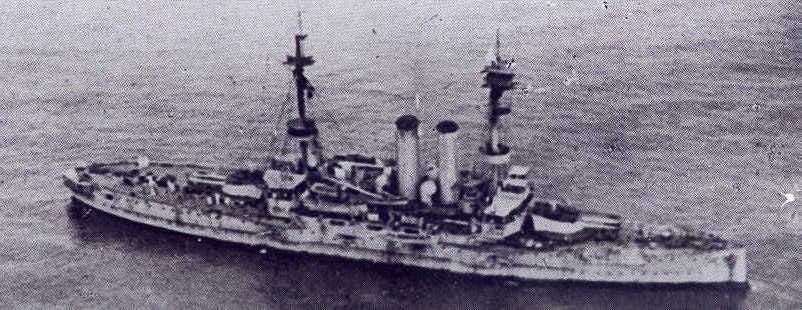
Similarly to the Vengeance’s men, the Ottomans began a powerful counter attack forcing the picket to fall back and the Irresistible to provide covering fire with her secondary 6” guns. As this gun duel roared on the demolition troops found and destroyed four of the six guns at the fort at Sed El Bahr which had been found undamaged. With the fort neutralised the Marines withdrew from the fort with only a few slight injuries though their attempt to push through to Fort Helles failed in the face of growing opposition but managed to find and destroy two 12 pounder guns they came across before withdrawing.
With the day drawing to a close the force withdrew and looked over the achievements.
In the plus column the area had been swept for mines and pronounced clear, several guns had definitely been destroyed and limited landings with Marines were seen to be effective.
On the downside the forts were still there and could have fresh guns put in them, the guns at Kumkale were in position still and despite heavy fire from Majestic the bridge over the Mendere river was still in position.
In all we penetrated the Straits to a distance of five miles pounding away like mad the whole time, and miraculously missing the hail of shells which was rained at as. In all we were hit four times, but the shots were small and the damage was negligible. Best of all, there was not a single casualty on our side, so it was argued that the old “warhorse” had acquitted herself nobly. - Petty Officer Cowie HMS Majestic
Historian E Kebble-Chatterton would later write that:
The enemy, being short of ammunition, but likewise being very shrewd, disciplined his hate till the opportunities were beyond doubt. The Majestic for example after closing in to within 5000 yards of Eren Keui, shelled it for a whole hour, without ever getting one single reply. “The Turks seem all to have gone to tea!” was the remark heard. - Dardanelles Dilemma
Carden was pleased with the outcome and whilst the weather was holding up he ordered de Robeck to continue actions the following day and stop the Ottomans from retaking the forts.
Dutifully the minesweeping trawlers went into action that night and a convoy of Marines and Naval Division troops was brought up for further landings but… At dawn the weather was blowing a heavy gale and rain making visibility atrocious so a full day of action, and the convoy of landing troops, was postponed.
Beast of a day, strong easterly wind and constant showers. Division remained at anchor all day - Midshipman H Williams’s Diary 27 February, HMS Agamemnon.
However opportunity had to be taken when it could and in the afternoon, when weather permitted, the Irresistible began operations with Marines being landed at Sedd el Bahr under Lieutenant F. H. Sandford. The Marines went in in the same style they had the previous day and the Ottomans responded in the same way and attacked from the Old Castle and pushed the Marines back to where Sandford was attempting to disable six Krupp 6” guns but they were disabled under fire at a range of around 500 yards. Four were destroyed and two had their breach ends blown all under the cover of the Irresistible’s secondary armament which targeted the villages and windmills. The force withdrew with no casualties and for his work over the previous few days Sandford was awarded the DSO.
Plans to start on 28th February also came to naught as the weather was even worse with horrendous north-east gales and rain which meant that they couldn’t even get in to perform a landing.
Wind storm force and squalls of rain. Remained at anchor all day. Wrote letter home. - Midshipman H Williams’s Diary 28 February, HMS Agamemnon.
As the sun rose on the 1st March the weather was still diabolical but not as bad as it had been and with the brass aware that every day they were not engaging gave the Ottomans a day to repair and regroup de Robeck was ordered to go in again.
Four battleships were earmarked for operations, three to enter the “swept zone” and shell any guns that made themselves clear whilst the fourth watched the abandoned forts in the rear in case they sprang into life again. With Vengeance withdrawn for boiler maintenance, de Robeck took the Chatham built Irresistible as his flagship.
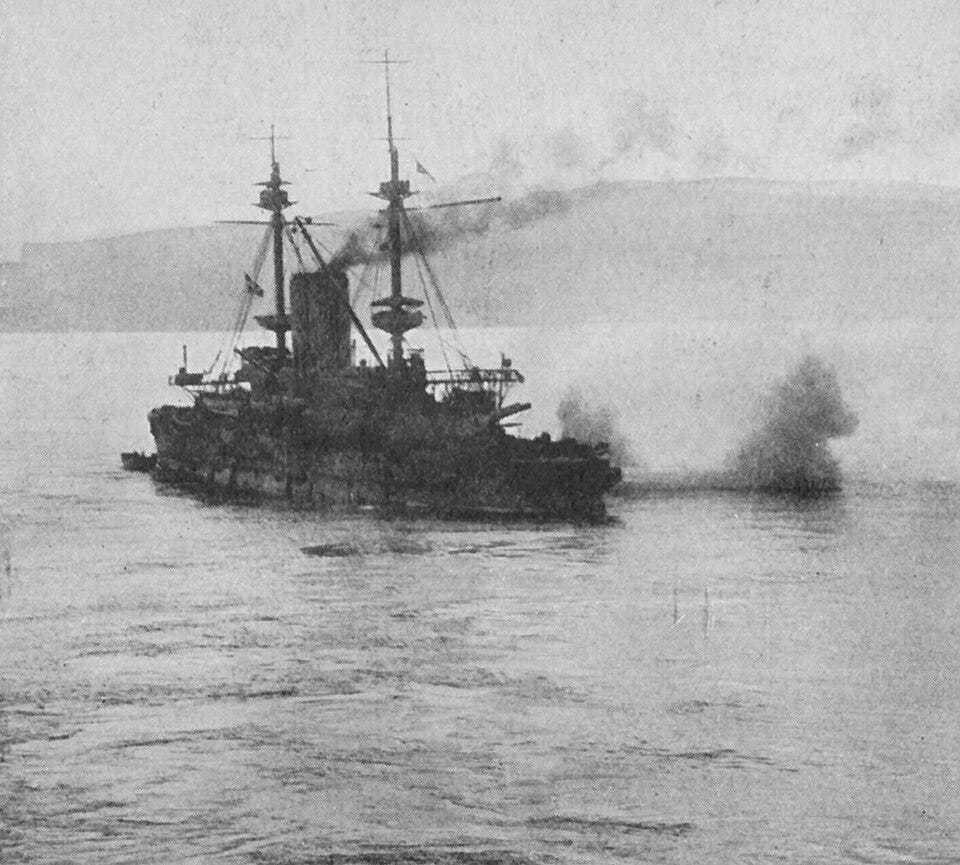
De Robeck wanted the Albion and Triumph to engage Fort Dardanos and look for a rumoured battery near White Cliff and the Ocean and her older sister Majestic to search for any mobile batteries. The morning started well with the Ocean patrolling the old castle and Sedd el Bahr looking for any guns or signs of movement until midday when the Majestic arrived and they proceeded up the straits.
The Turks were not out to tea on this occasion though and the guns around the Achilleum from two separate field batteries. Returning fire from the two battleships forced the guns to disperse and in the brief spell of quiet they proceeded back up towards Eren Keui where another battery of Howitzers began raining fire down upon them. At 12;30 the Irresistible arrived two miles below Eren Keui at Eski Kale to support Ocean and Majestic. By 1 p.m. their fire had been so effective that the Howitzers were silenced and dispersed, freeing up the Ocean and Triumph could turn to the European side.
This was easier said than done as the European defences opened up and had to be dispersed again by gun fire before Irresistible and Ocean were ordered to the mouth of the Straits and Albion and Triumph pushed on to Dardanos with two destroyers screening them. As the destroyers reached the edge of the swept zone they sighted what they thought was a mine and came to a halt to examine it and this caused the battleships to have to slow right down until they got out of the way which immediately saw them attract fire from the European side guns again forcing the two ships to circle to avoid being hit.
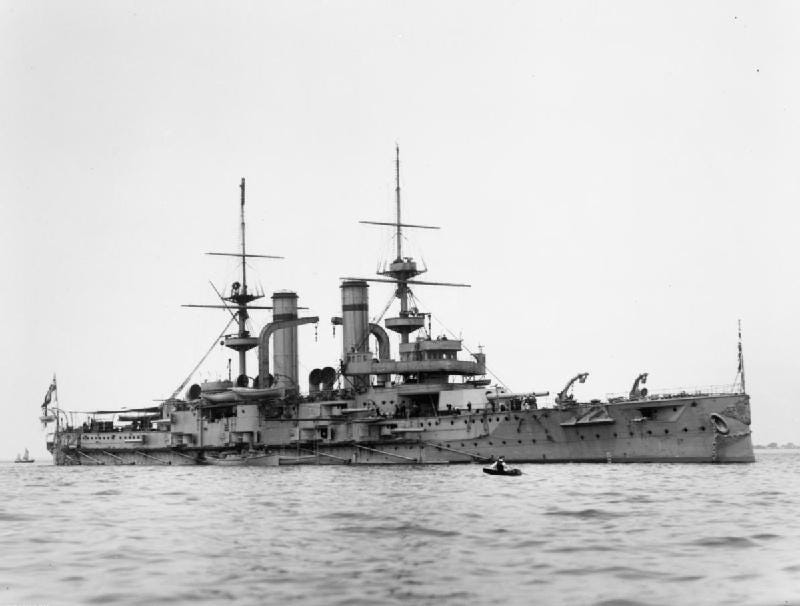
The Triumph’s crew prided themselves on their ability to hit fortifications and gun emplacements having had experience against the German fortifications and defences at Tsingtau the previous summer but even that was not enough under these conditions and instead they switched to the European side and Eren Keui. Triumph scored hits on redoubts and again, the sporadic fire in this area was silenced. At 2:25 p.m. it looked like they could push on to Dardanos again.
This optimism was short lived as when the Ocean made a turn she came under heavy fire from these hidden guns with such ferocity that the British ships had to sail in circles and return fire as best they could - but the enemy was well dispersed and hidden. Majestic moved in and used the howitzers on the top of her gun turrets at close range but the Ottoman fire was murderous and from both sides of the straits. Thankfully for the British it was not causing a lot of damage.
De Robeck gave the order to withdraw from the Strait and head back to the mouth and Triumph, Ocean and Albion moved to Irresistible at the mouth of the Strait where Sandford had again been landed to demolish Kumkale fort. The Triumph was moved into position to cover the intrepid sailors and marines.
Sandford found that the fortress’s main guns were pretty much all intact, save for one, and so Sandford demolished them all before turning his attention to the field guns nearby where he demolished a whole battery of six twelve pounders, a motor searchlight and four Nordenfeldt machine guns before returning to the boats.
I am pleased to say our ship has escaped very well, for we only had four men slightly injured, and one of them I regret to say was our townsman — James Ninnis Bennetts. I am afraid we shall not be able to make much progress until we have a big landing force, which I hear is coming. But it’s a great task. Imagine to yourself the boom of the great guns and the reply of the enemy, both dealing death at each other. We are now busy replenishing our stock, and expect to make another dash to-morrow. I hear there has been good work done to-day. - Leading Seaman Samuel Trevorrow, R.N.R HMS Albion published in the Western Echo in April 1915
Petty Officer Cowie of the Majestic wrote in conclusion of the events that:
After a very quiet night we started work in earnest the next morning. The Turks were certainly wasting no time, and were observed to be placing some field batteries into position on shore. Off we went to expostulate in the best practical fashion. All day we pounded away at them, and I dare say caused them no little inconvenience, but the actual damage could not be ascertained. We were subject to a pretty stiff fire all the time, but luck was with us and we came home for the night unscathed.
The day had shown some serious omens for future operations, mainly the dispersed field batteries and heavy fire from both sides of the straits which, although had caused little significant damage or casualties, had seen all of the ships hit and forced to take evasive action. It was also clear from the landing at Kumkale that no matter how much firepower was levelled at it there were still guns untouched, even in areas they considered clear. To make matters worse the Seaplane spotters reported greater activity and emplacements being established.
It would appear that the best way of reducing the guns on the Asiatic side would be by the employment of guns or howitzers on shore from the European side. The enemy guns protecting Eren Keui Bay, being mostly of movable armament, present the maximum of difficulties from a ship fire-control point of view - Captain FitzMaurice HMS Triumph
Roger Keyes, de Robeck’s adjutant, wrote on 2nd March;
The wind has come round to the southward again and our landing expedition - “Winston’s own” - has had to be postponed. It is extraordinary the preparations the Germans have made to prevent a landing - they must have spent thousands - wonderful trenches. Searchlights of the most modern and powerful description. One was mounted on a motor car. Pity we have had to destroy all the booty but we have not sufficient force to occupy the country round which commands the forts. While our parties are onshore, fire from these positions is kept down by fire from the ships. Last night the mine sweepers got a long way up and were fired at, but the destroyers replied and no damage was done. Several of the ships were hit but the only casualties were five wounded in the Albion. We really have had awful luck in the weather. Only one day since the 19th calm enough for the “flies”
So what to do? Give up on the Naval attempt to force the Narrows before there was a serious loss of life or ships whilst they could save face and wait for the army or press on pig headedly?