
UC II Minelayers
... and the action of 15 August 1917

Recently I wrote about the UB-III class of U-boat from the First World War and mentioned it was an evolution of the UC-II class minelayer without really defining what that was so…
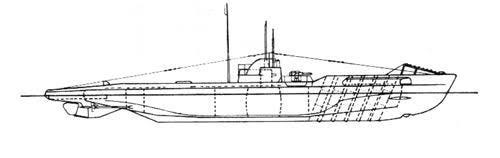
With the commencement of the First World War the German U-boat force looked at a steady process of evolving designs of their existing submarines including the UC-1 class coastal minelayer U-boat with many improvements to the existing design including increases in range and weapons.
The original three types of U=boat were the UB coastal class, UC minelaying and the sea going U class for anti-shipping. The UC-I class was acceptable but suffered from a few drawbacks which had become apparent during the first year of the war, mainly being underpowered and struggling in strong currents in the Channel.
This was not a massive problem as unrestricted U-boat warfare in 1915 saw the best efforts being carried out by the U Class and the future of the campaign but following the Lusitania and Arabic incidents and the tempering of the campaign a new strategic avenue was needed.
It was believed that the laying of mines in sea lanes and ports would achieve a similar success but was a bit more legally safer. There were at least some international rules and guidelines of mine laying with the publication of vague areas of the minefields meant the onus fell on the British to clear them and the Captains of individual ships to make the decision to sail through the field or not.
So the UC class was back to being the sharp end of the wedge but it was in need of an update, especially if it was needed to deploy to the Mediterranean by sailing through the Straits of Gibraltar rather than disassembling and transport by train to the Austrian ports.
The improvements for the UC-II class over the proceeding UC-I began with the main weapon of choice, the mines.
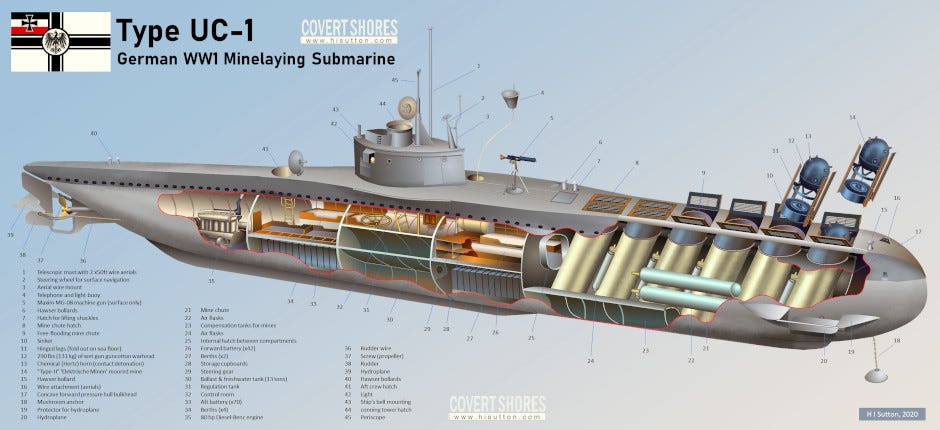
Although the type of mine, the UC/2000, remained the same the three shafts mounted in the hull were made deeper by an increase in the size of the U-boat which enabled each vessel to carry three mines for a total number of eighteen.
Unlike the older variant the UC-II was also to have other offensive weapons to make it a more all round weapon. This included a 88mm deck gun and three torpedo tubes with two mounted externally and one in the stern carrying a total of seven torpedoes. This would give any Captain options in any action or patrol.
The enlarged hull also housed two six cylinder diesels generating up to 650 SHP giving the U boats a top speed of up to 12 knots as well as electric motors (450-630 PS) which gave them a submerged speed of up to 7.4 knots and an overall range of up to 10,000 miles at 7 knots on the surface and sixty miles submerged at 4 knots.
Although this sounds pretty impressive there were drawbacks, there always are, but they were mostly due to the enlarged hull. The larger conning tower and forecastle made them quite hard to handle and also made the deck gun and tower very wet even in moderate weather.
The first batches of the class went into production on 21 August 1915 and by the end of the war there were sixty four built and commissioned though some 46 being lost to various causes throughout the War.
They were a decent submarine, despite the faws and saw quite a bit of action although forty six were lost in action.
An infamous member of this class was the UC-63 which sank thirty six vessels in nine patrols in ten months under Oberleutzent zur See Karsten von Heydebreck.
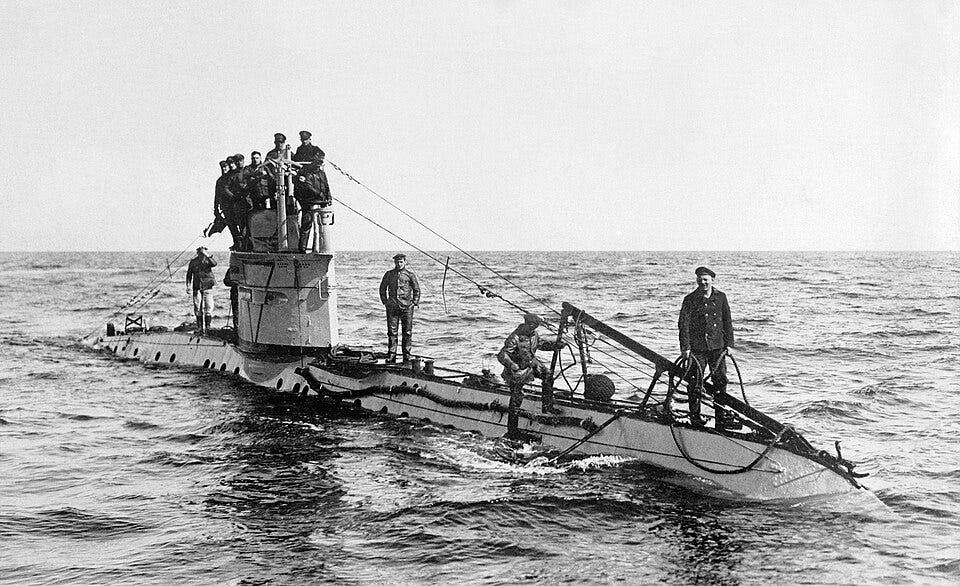
The shady part of the story revolves around the Q-ships Ethel & Millie and the Nelson on 15 August. It had become common practice for U-boats to attack the trawler fleet operating in the North Sea in violation of the 1907 Naval convention, possibly in vengeance for the blockade against Germany, possibly because the Captains just wanted ships sunk, in honesty I’m not sure and I really need to do more research on it.
Either way, the fishermen wanted protection and a few trawlers were armed as Q-ships whilst acting as fishing ships and on this day both vessels were fishing out on the Humber on the look out for U-boats and maintaining their civilian guise when they were engaged by UC-63 on the surface.
It was 2:45 p.m. when the Nelson came under fire from UC-63’s deck gun at a range of three miles. Captain Tom Crisp, a veteran fisherman and winner of the DSC for actions against U-boats in the region. He had only been in the RNVR since 1915 but knew his vessel and the waters.
Crisp knew that his vessel’s 3 pounder gun was out of range so the only option was to close the distance but the German fire was too accurate and soon the boat was holed and sinking and Crisp mortally wounded. The men abandoned ship and grudgingly had to leave their Captain behind at his request as he did not want them to slow them down. His son held him as he died and reported that he passed away with a smile on his face.
Tom Crisp (junior) joined the rest of the men in the lifeboat and began to bob ineffectually as the U-boat switched its target to the Ethel & Millie, who was also approaching and firing her gun. The second vessel did pause by the Nelson’s lifeboat but realised that they would overfill the fishing boat so they went to deal with the German intruder first.
They would never return and soon the Ethel & Millie was also sinking and the men were picked up by the U-boat and were last seen standing on the deck and being spoken to by one of the officers on the deck.
There are several theories as to what happened next.
The Germans put them back in the lifeboat and they perished at sea.
The Germans, who believed that any Q-ship crew men were nothing more than spies or saboteurs and therefore exempt of protection of law and shot.
…or in the worst case they were still on the deck when the U-boat submerged which would have dragged them down and drowned them.
No one knows for certain, indeed no one knows if it was definitely the UC-63 that carried out the attack but it is the most likely.
The U-boat was lost off the Goodwin Sands on 1 November after being sighted and torpedoed by the submarine, HMS E52 with the loss of the entire crew.
Thomas Crisp (senior) received the Victoria Cross for his actions that day and his son the DSO.
But much like the UB II class - is there anywhere I can see one?
Well… yes, occaisionally.
Very much in the same way as UB-122 out on the Medway, there is a wreck that is visible from time to time.
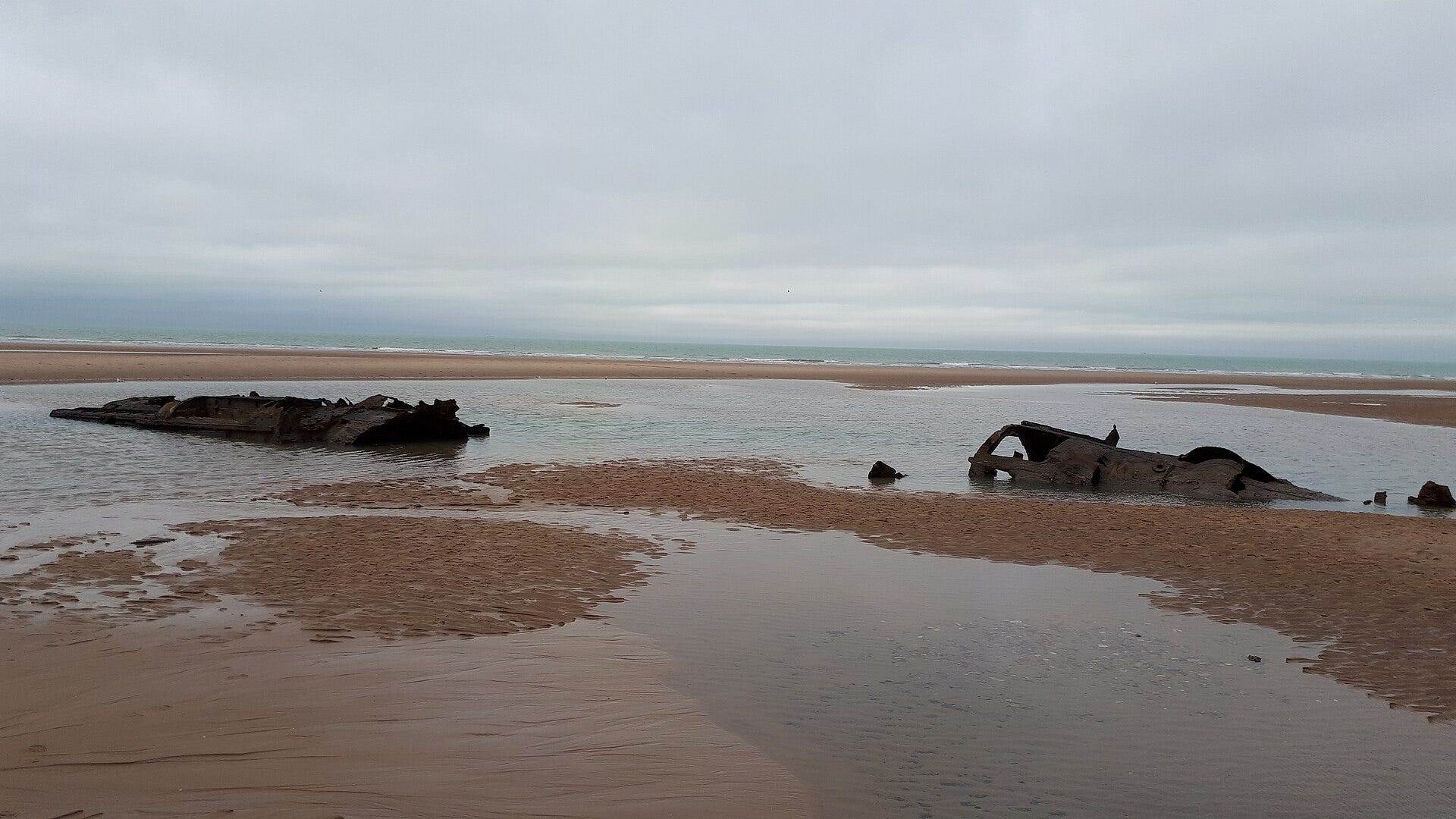
The UC-61, after a modest career which saw twelve ships sunk or damaged, became stranded on the sands off Wissant in fog, south of Calais. Her Commander, Kptlt Georg Gerth, ordered the vessel scuttled and made unservicable before surrendering to the French. The U-boat was lost into the sands on the beach only to reappear sporadically when the tides and sands were right. Since 2018 this has been more frequent and it is hoped that the wreck will attract visitors.
So it is easier to get to than the UB-122 but may not be there when you do…
Interesting article - thanks for sharing it.
This is so great. I see shadows. How much of it is under water?