
The Tegetthoffs
What is behind the names of the Austrian Dreadnoughts?

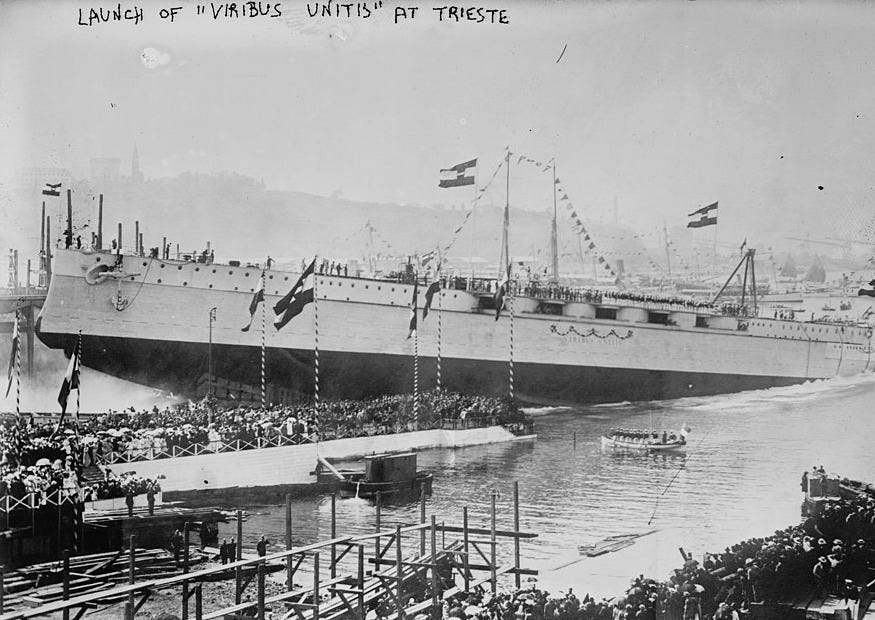
The Austro-Hungarian Kriegsmarine of the First World War is a navy that is often overlooked and although relatively small it had an impact on the naval war within the Mediterranean but what was behind the names of some of their ships?
The largest ships were the Tegetthoff class dreadnoughts, each carrying twelve 12” guns in four triple turrets and they could muster twenty knots of speed. There were four of the vessels - Tegetthoff, Prinz Eugen, Unitis Viribus and Szent Istvan.
Tegetthoff
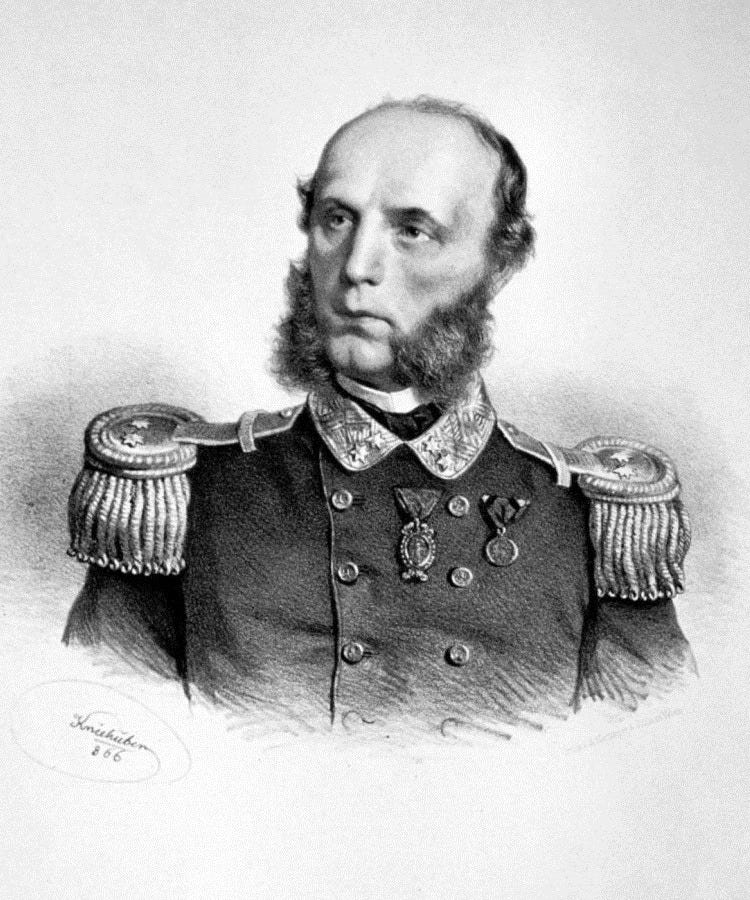
Wilhelm von Tegetthoff had been a commander of the Austrian fleet during the Second Schleswig War and later the Austro-Prussian War during the 1860s.
Born in 1827 in Marburg to an Austrian Army officer father. He joined the Naval academy in Venice (under Austrian control) in 1840 and was commissioned in 1849 when he took part in the blockade of Venice. Promotions followed in 1851 (Fregattenleutnant) and 1852 (Linenschiffsleutnant) followed by his first command in 1854, the SMS Elisabeth.
With the Navy converting to steam he took command of the paddle steamer, SMS Taurus patrolling the Danube estuary as the Crimean War raged.
In 1857 he was promoted to Korvettenkapitan and served on a scientific expedition to the Red Sea where he demonstrated diplomatic and organisational skills which saw him promoted to the post of Staff Officer. The following year he was promoted to the screw driven corvette, Erzherzog Friedrich and ordered to patrol the Moroccan Coast.
During the Italian Campaign of 1859 the Austrian fleet was neutered by the French Navy and played little if any role during the conflict but von Tegetthoff saw promotion to Fregattenkapitan in 1860 and Linienschiffskapitan in 1861 before being put in command of the Levant Squadron where they policed the waters and represented Austria’s concerns during the Greek revolution.
The Second Schleswig War in 1864 between Prussia and Austria against Denmark required Austria to provide naval support for the fledgling Prussian Navy and Tegetthoff led a squadron to assist. The only battle that Tegetthoff took part in saw the Danish Squadron that was blockading Heligoland and north German ports victorious at the Battle of Heligoland. The Austrian flagship, the screw frigate Schwarzenberg was heavily damaged and set on fire but the Austrians fought well under their Commodore and the Danish squadron was forced to withdraw from its blockade. A grateful Franz Josef I promoted him to Konteradmiral and gave him the Order of the Iron Crown.
His greatest victory was the Battle of Lissa during the Seven Week’s War with Italy which I’ve covered here in detail. It was a resounding victory that had an effect on Naval design well into the early twentieth Century and propelled von Tegetthoff into hero status for Austria, promotion to Vizeadmiral and decorated with the Commander’s Cross of the Military Order of Maria Theresa.
Post War he went to study in France and Britain as well as travelling to Mexico to bring the body of Archduke Maximilian of Austria, who had been also serving as Maximilian I of Mexico until his execution, back to the Imperial crypt in Vienna.
He was finally promoted to Marinekommandant in 1865, the chief naval administrative officer and three years later took up the position of Chef der Marinesektion (Chief of the Naval section) within the War Ministry. where he began reforms of the Navy. His career was cut short by pneumonia in 1871 aged only 43.
Sxent Istvan
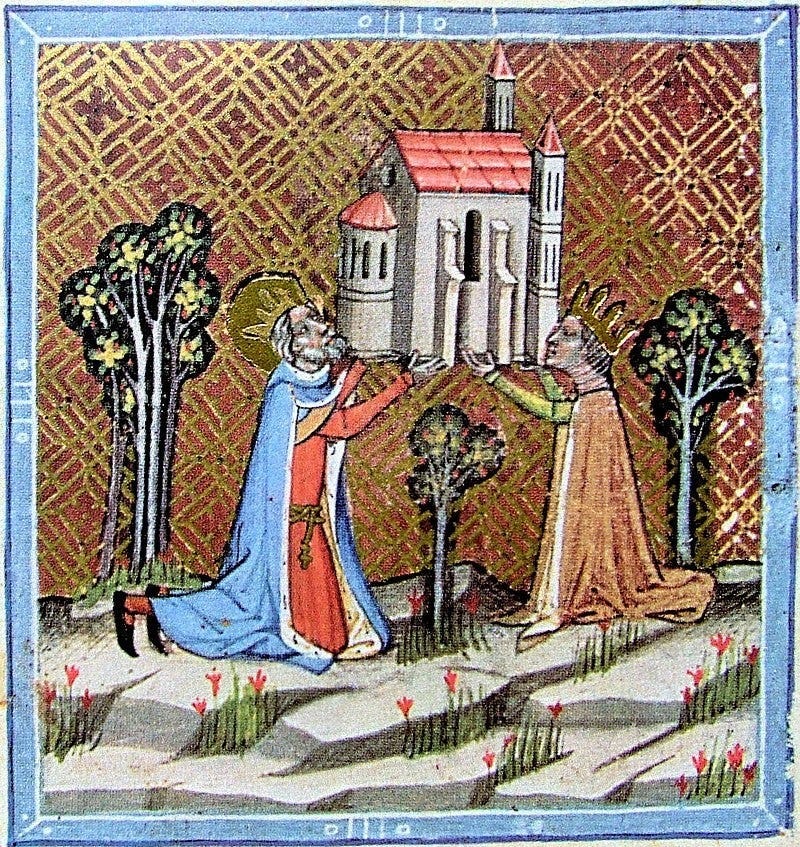
Stephen I of Hungary or St Stephen, lived between 975-1038 CE into the Arpad dynasty and he was the son of a Magyar Chieften named Goza. Although a Pagan he was later christened and raised as a Christian and he would later marry Gisela, the daughter of Duke Henry II of Bavaria.
He would fight a contest for his throne after his father’s death and executed his Cousin (the usurper) after the battle of Veszpriem (998) and he became King of Hungary on Christmas day 1000, crowned by Pope Sylvester II.
His reign was marked, mostly, by peace in the region, despite a few small disputes with Poland and an invasion by Conrad II’s Holy Roman Empire in 1030. The kingdom was organised along the same models used in Germany and also saw enforced Church construction as well as Stephen’s foundation of Abbeys and hospices. Other measures included promotion of agriculture, strict laws, creation of a ruling class and the opening up of Hungary to foreign influences as well as sending missionaries to his kingdom to spread the word of God. For all this Godlyness he became Hungary’s patron saint.
The name was chosen to try and encourage Hungarian politicians to pay for the ship within the twin parliaments, something they were always loath to do as Hungary didn’t really have much interest in naval plans. The Austrian half of the Empire played to the Hungarians by having the ship built at the only Hungarian shipyard and named after a Hungarian folk hero.
Viribus Unitis.
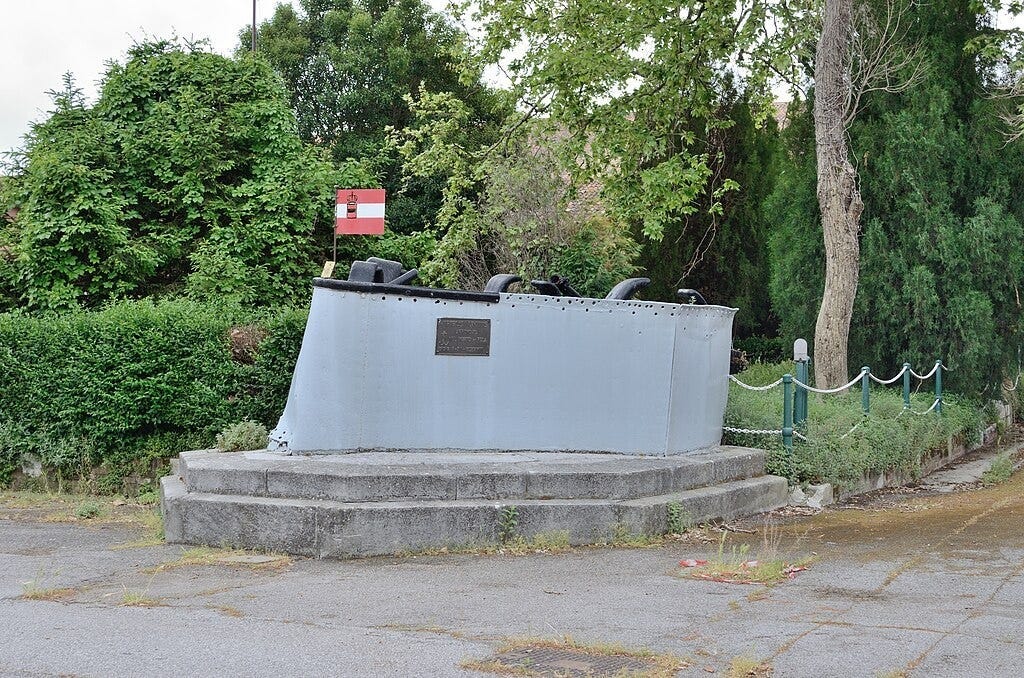
There is not much behind the name of this vessel, later renamed Jugoslavia when taken over by the State of Serbs, Croats and Slovenes. The name translates as “With unified forces” and was the motto of Kaiser Franz Josef I and it could be used to show that Austria and Hungary were unified in their aims and force.
Prinz Eugen.
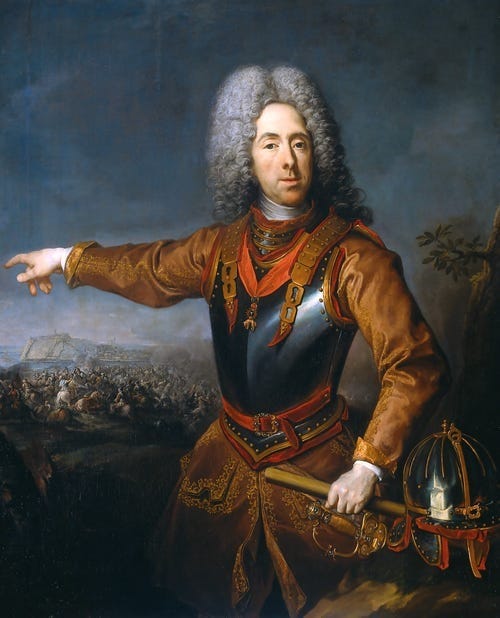
Prince Eugene of Savoy was another Austrian War hero and Feldmarschall who lived between 1863=1736. He was born in Paris as the youngest son of the Comte de Soissons of the House of Savoy-Carignan. After falling out with Louis XIV, Eugene offered his sword to Emperor Leopold I, the Holy Roman Emperor and he quickly came to prominence following the relief of the siege of Vienna in 1683 and was gifted command of a force dragoons. He showed a great genius for military affairs and strategic thinking which led to victory after victory and led to his promotion to Field Marshal at the age of twenty nine.
He racked up victories Zenta, Peterwardein and Belgrade wrested control of Hungary from Ottoman control he also was victorious at Bavaria, Blenheim (although his friend the Duke of Marlborough took the laurels), Turin and also the battles of Oudenaarde and Malplaquet in Holland. He did lose battles in Spain but this was more down to the Emperor Charles VI being rubbish at politics rather than Eugene being a bad soldier. In his career of 39 years he took part in 24 Battles and suffered 13 wounds serving three Emperors. He was one of those Military leaders that ascended to legendary status just by true determination and ability.
His most famous victory was the Battle of Belgrade in 1718 where he gambled on the positioning of his forces as the Ottoman force which was attempting to lift the siege, outnumbered his diseased troops four to one but he smashed the relief force and took the city.
An absolute era defining military titan for Austria.