
The problem with Major Konig
On post war perceptions of the German military

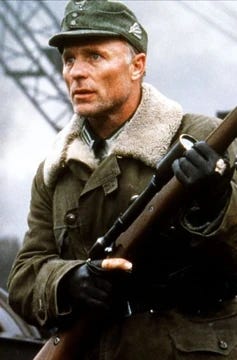
I didn’t sleep well the night before I drafted this (Monday 4th August last year) and the resulting dreams sparked this question and its follow up mental rabbit hole and answer.
For those who haven’t seen the 2001 movie “The Enemy At the Gates” I should explain the plot and character of Major Konig.
The basis of the film is the semi-mythical confrontation between Vasily Zaitsev, a shepherd boy from the Urals who has been drafted to Stalingrad and the head of the German sniper school, Major Irwin Konig. There are several set scenes and sniper duelling moments in which both snipers show off amazing skills that match each other. At the end of the movie (and spoilers) the Major executes the Russian boy who had been cleaning his boots and working as an informant for the Russians and then there is the final battle in which Zaitsev defeats the Major. The big problem with the movie is that in building Konig as a credible protagonist it all comes down to his skill and he becomes somewhat likeable (and Ed Harris is very compelling) but you can’t root for the bad guy and you need to be reminded he’s on the side of evil hence the murder of the boy.
An interesting choice for the movie is that there are two versions of the Zaitsev story, one with the Wehrmacht sniper, Konig, and a SS super sniper. It is an easy movie trope that if you want an easy bad guy in a movie you have a Nazi. With a Nazi you don’t have to write a backstory as to why they are evil as the audience already knows that Nazis are evil, or at least I hope so, and a SS uniform is synonymous with evil. Indeed if writers want an easy way to create a villian in a piece they just put them in SS uniform because then you don’t need to write a decent backstory as to why they are the bad guy because they are Nazis - so evil. The Heer and Wehrmacht uniforms doe to a certain degree but it comes with problems as well.
However this poses a further question about German war heroes and memory.
Another anecdote is that I was playing Call of Duty 3 and my son Ollie wandered in and was watching. He was uncertain about shooting the enemy after all these bad guys were humans. I explained that as soldiers of the Third Reich, as the foot soldiers for evil it was acceptable to shoot them and that when fighting evil you have to do what is needed and that in not defeating the German military means that the Reich endures and more people will die. Sophie, my daughter, pipes up.
“What if these people are not Nazis? What if they are conscripts? What if they are fighting for their families or because they have to fight?”
These are valid points and it is a question German culture has struggled with post war.
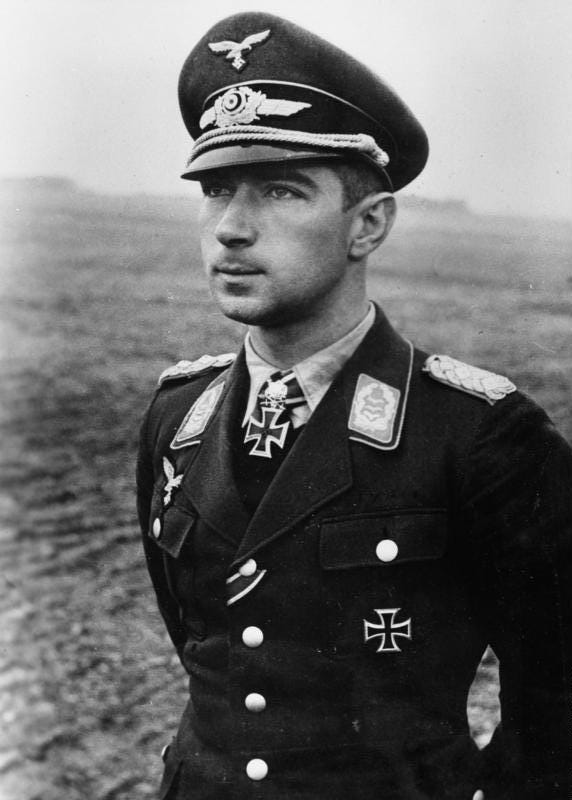
As a teen I played a lot of flight simulations of the Battle of Britain which is where my interest in the Luftwaffe came from and I thought very highly of the fighter Ace Werner Molders. As a pilot he was a very efficient fighter Ace, he scored victories in Spain, France, over Britain and finally during Barbarossa reaching (officially) over one hundred despite suffering from air sickness in his early career. He was a dedicated Commander to his men, well respected, a keen tactician who developed the Schwarm formation and he was made General of Fighters. In November 1941 he was killed in an aircrash as a passenger whilst flying back to attend Udet’s funeral. He was a staunch Catholic and there is evidence that he had argued with the regime in a minor way and was more than likely on a watch list and there are unsubstantiated conspiracy theories that he was killed by the regime.
The problem is, he is still a soldier of Nazism and evil even if he has a good heart.
Post War Germany had serious problems with rehabilitation as so many people had an links to crimes against humanity and war crimes whether it was knowledge of things and looking the other way, railway workers, civil servants, police officers, judges and civil servants. Post Nuremberg there were several people who had been steeped in knowledge of the crimes of the regime who were set free to go back to their jobs afterall Germany stll needed to function and so levels of guilt were accepted. There were also those who would be useful to the two sides of the growing Cold War who were grabbed and granted freedom in exchange for services.
Further to this, Germany needed some heroes who could be good soldiers but not Nazis for obvious reasons. Names such as Lutjens, Stauffenberg and Molders were accepted as they were either professional soldiers or fought the Nazis. The same was true for military officers as a Post War West Germany would need people to command and that meant former solders and sailors of the Wehrmacht and many familiar names come up as serving.
Molders’ name was attached to a fighter squadron, much as it had in the War, there was a Signals detachment and even a destroyer. There was a problem though, Molders had served in the Kondor Legion in Spain and on the sixtieth anniversary of the Gurnica bombing the German parliament decided that no one who had been in the Legion should be honoured. Following an investigation it was decided that Molders had not done enough to distance himself from Nazism before his death and all the units were renamed in 2005.
Stauffenberg is also similarly problematic as he was a keen supporter of Nazism at the beginning of the War when Germany was ascendant and only began to disagree with the regime when it was going badly and the Resistance did not say they would end the War either. Tresckow’s name is linked to the Heuaktion, the kidnapping of 40-50,000 Polish and Ukrainian children aged 10-14 for the Force Labour program. However both are hailed as heroes of the Walkure attempt because they did stand up to the regime. Whether a successful Walkure would have been a better state or continued in much the same way is up for debate.
This probably doesn’t extend to all of the “other ranks” as the average sailor, soldier or airman probably did not have a direct role in war crimes or crimes against humanity beyond the fact that they are fighting for the cause and/or might support the ideals of nazism. This gets more complicated on the Eastern front where war crimes by both sides is common place and the rules of war become more guidelines than rules.
There is the post war “Clean Wehrmacht” myth but I’m not going to entertain that as the Army were heavily involved in things as were the Luftwaffe ground formations with the air wing similarly tainted - Dr Phil Blood and Dr Victoria Taylor have both worked on this and their definitely worth checking out if you are interested. The Navy is somewhat more difficult as although there were moments of involvement in shipping slave labour or the Cap Arcona affair. The question of U-boats sinking civilian ships as part of an unrestricted submarine warfare was found to be somewhat justified at Nuremberg.
Although, this is on paper is a horrifying act of armed soldiers sinking an unarmed civilian ship without warning and then leaving the survivors in the water, it is considered a part of “Total War” akin to bombing factories full of civilians or residential areas. Donitz was prosecuted by the tribunal at Nuremberg but when the defence called Admiral Chester Nimitz to the stand and asked what his submarines had done in the Pacific the case was quickly dropped.
However I come back to the original point - Nazi soldiers, right?
It is a difficult line to draw and I suppose if I was being forced to I’d say respect the acts of bravery and not the person.
Molders was undeniably an excellent fighter pilot, tactician and commander. Hartenstein’s attempt to save the passengers and crew of the Laconia was a compassionate heroic act and politics doesn’t come into that part of it. At the same time though you can despise the State and its politics that they were fighting for.
So where does that leave the fictional Major Konig?
Well his undeniably an amazing sniper (the movie is a bit ropey and Jude Law is… but Ed Harris is amazing and the sniping scenes unmissable so it is worth a watch) and commits no war crimes in the timeline (I’d argue the summary execution is legitimate as Sascha was a confirmed spy) and his motivation is to avenge hiself on the Russians for the death of his son who died in the early days of the battle. I think he is an amazing character and portrayed well though I don’t think the writers thought that Konig would pose such a dilemma at 2 a.m. which needed answering in this sleep deprived manner!
One of the problems of studying the German war machine of the Second World War does lead to people often making the suggestion that you have sympathies to the regime and although there are some bad characters who definitely have those sympathies there are many of us who don’t but Social Media doesn’t always allow for that.
One of the reasons I focus more on the First World War these days is that you don’t have to worry about the political nature of the conflict. Germany, as an Imperial power, was no worse than any other power involved though the savage German occupation of Belgium was particularly heinous and the Armenian genocide just to name two. There is no chance of being called a Nazi though!
In the style of Columbo - there is one more thing…
I once got into an argument on X/Twitter (where else?) with a Holocaust historian (I won’t name names) about Admiral Canaris. I had stated that his escape from internment in Chile and his subsequent U-boat career in the Great War marked him out as a hero. The reply came “He’s a nazi”
Yes, yes he was. Despite the good press Canaris gets for working with the resistence during the War and his eventual murder in a Concentration Camp during the Reich’s death throes, he had indeed been an enthusiastic supporter of Hitler and anti-semitism.
“Its like saying Goring was a great fighter pilot.” was the follow up.
I mean… yeah he was.
I’m not saying that Hermann Goring was a great man - he really wasn’t and even his fighter pilot career has a lot of question marks over it but he was an accomplished pilot. Canaris was an excellent Naval officer. You cannot judge a person on what they will do and believe in twenty years time.
History and humanity is not black and white, there are no heroes and villians but so many shades of grey and complications. Judge the action and
Any way it is a difficult question and I’m interested to hear opinions and thoughts on this in the comments and of course feel free to disagree with me on the movie too. Apologies for this being a bit of a random train of thought and I’ll return to Naval history in the next post. Also sorry if this has been a random thought train rather than a cogent thought process.
If anyone has thought I use AI to write my posts I’m pretty sure that this post answers the question, hence the spelling and grammer mistakes and rambling style!
It is tricky and layered or it is black and white.
The B&W position is nice and clean and allows for a certain self righteousness (and forbids any anxiety). It is the deontological position. Churchill was an imperialist and racist (and a few other things) therefore Churchill = bad.
Or Churchill was the saviour of the nation in the face of an unalloyed evil and saved this country from tyranny, therefore Churchill = good.
Or Churchill was a man of his imperialist and racist times, who was a terrible Chancellor of the Exchequer and Home Secretary, and a somewhat more checkered First Lord of the Admiralty than his reputation allows [video hint], who had one supreme moment of being the right man at the right time doing the right thing. Therefore Churchill = a complex man.
Complexity seems the more adult outlook to hold. But it lacks satisfying clarity and decisiveness. No one (presumably) wants to hold that Hitler wasn't all bad because he liked dogs and was a vegetarian. Not that doing a lot for charity and loving your mum can do anything to redeem Jimmy Saville.
Tricky.
A problem with Major Konig in Enemy at the Gates is that major is where ranks start getting serious. You have majors in charge of hundreds of men.
Why isn't he at work rather than futzing around like he's an infantryman?
A competent staff would send a specialist NCO or a dedicated sniper unit, not absurdly waste a field-grade officer on it. Someone would get yelled at for this, I assume. Wouldn't a major be better used as a battalion commander?