
The First X Craft...
HMS X!1, Chatham's secret submarine

The First World War had exposed the world to the frightening possibilities that the submarine could do and, despite Britain’s wish to see them banned as a weapon of war, the Royal Navy were keen to experiment.
The ill fated M-class are perhaps the most famous but there was also the submarine HMS X-1.
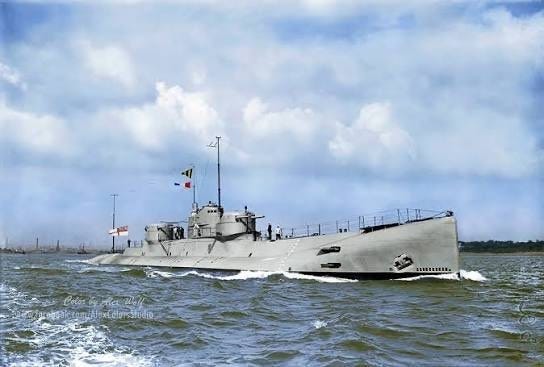
Although it would be easy to say the X1 drew its origins from the German Navy’s successful Deutschland design - and to be fair I often do give Germany credit - it was conceived in 1915. There were some German ideas from the U-Kreuzers, both built and planned, which were absorbed into the design but it was not a straight copy.
For various reasons it never saw fruition during the War but remained as something to look into. They began this process in 1918.
The X1 was laid down at Chatham Dockyard’s Slip 7 on 2 November 1921 and was designed as a long range commerce raider with fire power equal to taking out a convoy escort and then their charges alone. This consisted of two double mounted 5.2” guns and six torpedo tubes.
There were some drawbacks to this configuration though.
The first was political as the Washington Treaty was keen to stop a repeat of the unrestricted U-boat campaign on civilian ships and banned any submarine use for anti-commerce. This meant that her construction had to be shrouded in secrecy.
The second was a design and technical issue.
The torpedo tubes came from a L-class submarine so were tested and fine but the cramped torpedo room meant it would take up to half an hour to reload! The tubes also had to have new reinforced clips as the L-class did not dive as deep as X1 and the existing clips would not be able to withstand the water pressure at a deeper depth and would rupture. X1 also only carried twelve torpedoes with one in each tube and one per tube in reserve. This would mean for a convoy engagement she would have to rely on the guns.
The gun turrets were unarmoured, which was not too much of an issue as the low silhouette would make her difficult to hit. They were situated one forward and one aft with fire control stations in the conning tower and a range finder on the bridge. Each gun had its magazine hoists travelling from the turret into the pressure hull, but they were problematic and slow so the standard naval six wounds per minute was more than a bit optimistic.
On the flipside though, the magazines had their own ballast tanks that registered the firing of a shell and would bring on water to compensate for the weight differentiation. As each magazine had 400 rounds in it it would make sense that at the end of a gun duel she would be a lot more buoyant in the water without the extra weight.
The other cool thing she could do was that they could use the range finding periscope to locate and swing the turrets around whilst she was under water as well as elevate them to be able to range the target. The gunners would be ready in the hatch below the turrets and when she broke the surface they could run up and man the weapons. It was found she could go from submerged to firing her first salvo in around a minute and a half! In trials she was able to fire eight salvoes in two minutes with five straddling the target which is really quite impressive.
Beyond the armament she was 353 feet long, the largest submarine as yet built, and a beam of 29 feet 9” with a draught of 15 feet.
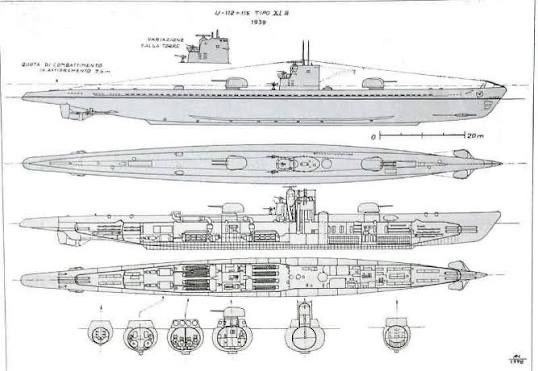
The pressure hull, divided into ten watertight compartments, was an inch thick and gave it an operational diving depth of 250 feet but a design depth of 500 feet.
So what engine did she have under the bonnet?
The main propulsion was two Admiralty 8 cylinder engines with a total of 6000 HP whilst two General Electric company engines (total of 2000 HP) would be used for underwater travel. You probably thought I had got away with the briefest of mentions of U-boats but there is a piece of the German navy at the heart of the X1 in the form of two of SM U-126’s engines for battery charging.
She was able to do an impressive 19 knots on the surface and 9 knots submerged. If she kept to 12 knots on the surface she had a range of 12,400 nautical miles, which was greater than a C-class Cruiser (HMS Caroline) which had a range of 5900 nautical miles, though her engines were plagued with reliability issues.
She also carried an ASDIC, one of only two in the world. which could be used to find vessels on the surface and even submarines below the surface as well as chart the bottom of the sea to see where they were.
On her launch the X1 was photographed by a journalist and it was going to be published by a national newspaper but when the Admiralty got wind of it they quickly confiscated all of the copies and had them pulped to stop foreign powers from getting wind of it. To counter this they also began a misinformation campaign that the submarine was an absolute failure and the whole project was going to be shelved, all the whilst continuing to finish up fitting out and commissioning of the submarine.
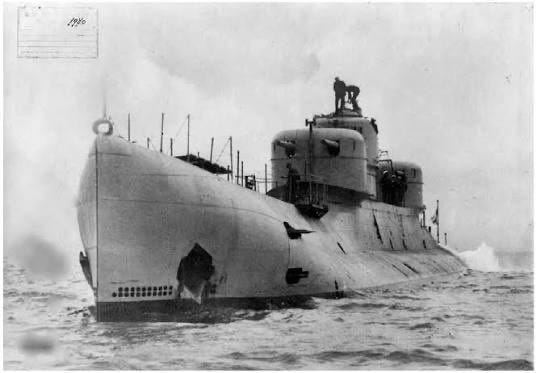
During her trials it was found that she did have excellent handling capabilities despite her size
It was found that once in service the engines suffered from severe vibrations and were prone to spurting oil and so had to be downgraded to 2200 HP each and were continually problematic. Her top speed would go down into 16 knots to combat the engine strains and vibrations. The German engines were also made badly as the materials needed to make them properly had not been available during the British wartime blockade, which made them downgrade quite quickly through her career. There was also a slight bleed of diesel at depth caused by the riveted fuel tanks but nothing could really be done about this.
Her handling was pretty good and if anything she was too buoyant at times but this was quite quickly rectified with some extra ballast and an extra set of fore hydroplanes.
She was deployed to the Mediterranean and Malta where she could get regular repairs but the clear seas made her quite visible from the air. She did carry out a lot of tests, and was often at sea and carrying out exercises but it put a massive strain on the troubled engines - and thus operating costs! It was for this reason she was put into reserve in 1930.
There was a possibility for new upgraded engines to be fitted and the faults that she suffered being rectified but with the international treaties limiting submarine fleet tonnages and her operating costs saw her reserve status confirmed and she was eventually scrapped in 1935. The sad part is that her career was marred by the continuing misinformation campaign that the Admiralty was spreading and that was that the submarine was an abject failure. The reason for this is that they didn’t want the other powers to start tinkering with the idea of a “Cruiser” submarine if the British couldn’t have a force of them.
If anyone is a fan of Drachinfel’s channel on Youtube, and let’s be honest I am the Coke Zero of Drachinfel’s work, then you may have seen his lengthy discussion on the X1’s design and origins which I found after I had written most of this. In it he suggests the possibility of X1 or similar vessels being a very good option for work in the Pacific campaigns against Japanese troop convoys in the early days when they had poor anti-submarine escorts. In Europe there would have been little they could have done but the Far East… it is an interesting what if?