
Lost and Found
The fate of HMS Hawke

HMS Hawke is one of those countless vessels that serve with in the Navies of the world that are somewhat nondescript and would have escaped the history books but for two events that would mark her career.
One was a collision with the liner Olympic and the other was her sinking in 1914.
Why does this matter? Well… they have just found the wreck - BBC Story on it.
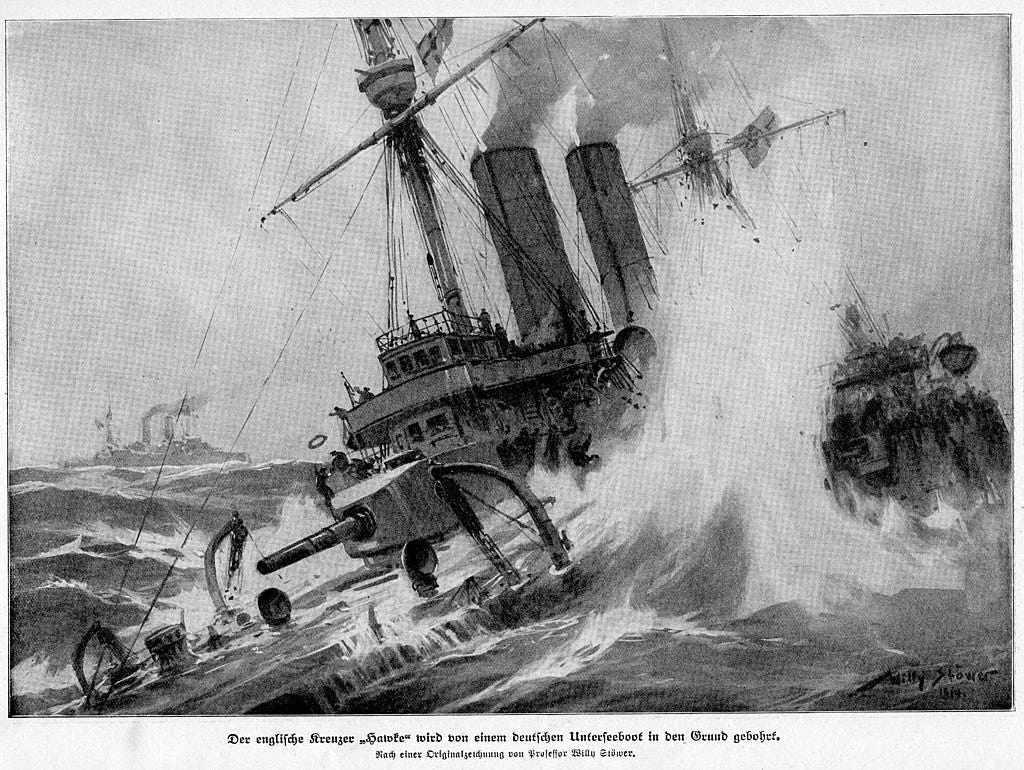
The Hawke was an Edgar class protected cruiser which were built in reaction to the 1889 Naval Defence Act which was part of the Royal Navy’s expansion and modernisation to meet perceived threats from France and Russia.
Of the nine Edgar class, the Hawke was the second to be laid down, on 16th June 1889 and the only one built at Chatham Dockyard and launched into the Medway on 11th March 1891 before being taken up river to Sheerness for Commissioning on 16th March 1893. She would then go on to serve in the Mediterranean fleet for the next ten years and was involved in the international squadron off Crete in 1897.
As I said, her career was fairly unremarkable, or average for a lot of the other vessels in the fleet until the 20th September 1911.
The flagship of the White Star Line, RMS Olympic (Titanic’s older sister) under Captain Edward J. Smith, was passing the Isle of Wight out to sea to the right of the Isle. The standard signal of two blasts of her ship’s whistle was made before she began her turn to starboard. The Hawke was coming up following a parallel channel on the opposite course and at a fair pace (though the witness report I read could only estimate Olympic as going 15-18 knots and Hawke moving at a fair pace) but as they approached the Channel junctions the Hawke began to slow her approach and fall in behind the liner.
Perhaps three to five minutes later I crossed again to the starboard side and was surprised to find the Hawke in the position indicated in Fig. 3. The Olympic had completed her turn and had straightened on her new course. The Hawke was coming up fast, on a parallel course, perhaps 100 to 200 yards from the Olympic,
The Hawke was getting closer to Olympic and at the last moment seemed to swing into a right angled turn straight into the starboard side of the Olympic’s stern.
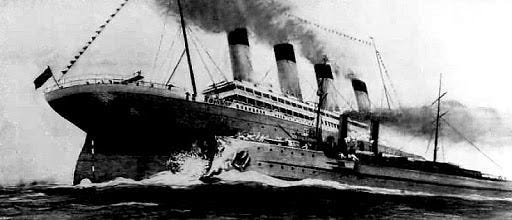
The Hawke was fitted with a ram-bow which was designed as a secondary weapon for fleet engagements and was basically reinforced to allow the cruiser to ram, trierime style, into other vessels as a way of sinking the enemy quicker than gunfire. This was a relic from the mid to late nineteenth Century after the Battle of Lissa, 1866. Although the size of the cruiser compared to Olympic and with the liner’s added safety devices like the water-tight compartments, there was little chance of sinking Olympic there was a danger to lives onboard.
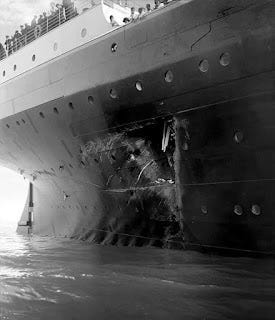
Thankfully all that resulted was a 40 foot gash under the waterline and also above it impacting eight feet into the liner! The resulting damage sees the Solent’s waters flowing into the ship and flooding two of the watertight compartments and bending one of the propeller shafts. Olympic began to settle by the stern but managed to limp back into Southampton under her own power.
So how badly damaged was Hawke?
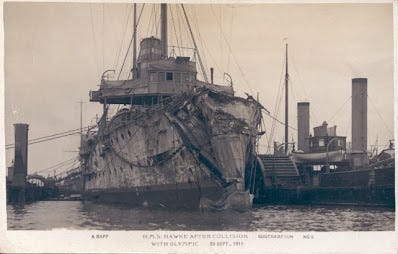
The Hawke’s ram bow was completely crumpled and she was rebuilt with a more modern straight bow.
In the post incident enquiries it was found that Olympic was entirely at fault for the incident and that the Hawke was an innocent victim. Though White Star Line tried to argue that the vessels collided due to the suction of the large size of the liner which must have pulled the smaller vessel in. The Royal Navy, however, were not happy with it and pushed that White Star should pay for the damages caused as there was no way a Royal Navy vessel would ram a civilian liner so it must have been the Olympic making her turn at a dangerous time.
It was a financial disaster for White Star as not only was Olympic out of service and back at Harland & Wolfe dry docks so not earning money from voyages but also her repairs saw resources diverted from the construction of her sister, Titanic, delaying her commissioning.
As the First World War began the Hawke was assigned to the 10th Cruiser Squadron consisting of the rest of the Edgar class. These vessels were very obsolete by the commencement of the War and would not have been of any use in a fleet eng
agement with the modern German Fleet but they could carry out secondary duties which freed up vessels to support the Grand Fleet and the Edgars took part in blockade duties patrolling the sea between the Shetlands and Norway.
On the 15th October the Squadron were operating in a more southerly position off Aberdeen as it was feared German ships might try and push through the North Sea and out into the North Atlantic and attack a troop convoy from Canada. Their usual position was now being covered by Duncan class pre-dreadnought battleships.
Elements of the 10th Squadron were operating in standard sweep formation in line abreast with a gap of 10 miles between each and zig-zagging to avoid U-boat attack as only a few weeks before (22nd September) the U-9 had caught and sunk the armoured cruisers Aboukir, Hogue, and Cressey and the Admiralty had warned their vessels to take more precautions.
Again, following standard operating procedures, the Hawke slowed to stop and lowered boats to cross to Endymion at 9:30 a.m. to collect post. By the time this process had been completed she was out of position and out of sight of the rest of the squadron so she proceeded at 13 knots in a straight line to resume her position. All perfectly normal and safe as long as there were no U-boats out in the depths.
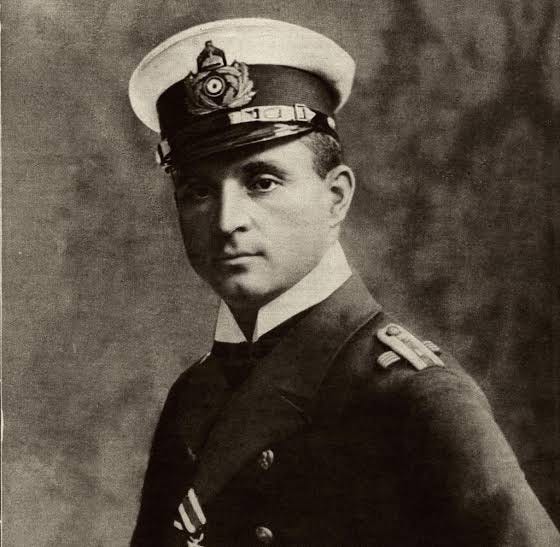
The Hawke was not alone though.
Kapitanleutnant Otto Weddigen, the same commander who had sunk the Aboukir, Cressey and Hogue was operating in the same area and he and his officers had been watching the squadron for quite some time.
On the 14th October the U-9 was at 57-30 North, longitude 0-25 East with Weddigen observing faint smoke smudges on the horizon. After careful consideration he decided that this smoke had to be a warship and ordered the petrol engines turned off in preparation to dive. Oberleutnant zur See Johannes Spiess, the Torpedo officer tried to convince his Commander that there was no reason to go hunting and that they should use the clear weather and new charts for Scapa Flow and make an attack on the fleet at anchor but he was overruled. Instead the U-boat sat motionless on the surface bobbing up and down in the clear moonlit night being passed by other steamers until the early morning when the order was given to dive with Spiess recalling;
I was concerned with other matters and had fallen fast asleep after having finished the mid watch. In my hurry, I had to climb the ladder in the conning tower in my stocking and without coat, a circumstance which happened to me only three times in the whole war. In running through the boat I had heard the very unpleasant words, “A warship is right close aboard.
When I got into the conning tower the dogs were just being secured on the hatch and the blowers had started on the tanks. Weddigen stood before me and having given all te necessary orders asked over my shoulder of the Chief Quartermaster. “Will we get clear?” The situation was therefore highly critical and I hastily took a look through the port of the conning tower. “For all time”
Noticing a warship close aboard to starboard which was apparently helpless as a target close by the guns of the enemy ship and we sighed with relief as the green waters of the North Sea closed over the conning tower port. Had the enemy overlooked us or was he unable to get his battery clear in time?
The vessel was actually further away than the German crew had originally believed and was zig-zagging which meant Weddigen’s planned immediate attack was postponed and every time they tried to get a position the ship moved. Over the following hours they sighted several neutral steamers passing by and another warship of the same class. The vessels tactics were too good and the U-9’s crew believed nothing could be achieved this day though they continued to patrol in the hope one might come about.
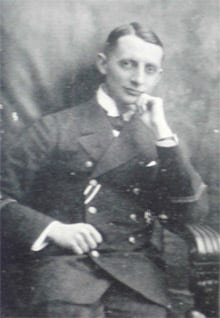
At 10 O’clock I went below for breakfast - cursing the cowardly English, the disturbed nights rest and the bad air in the boat - it was usually ventilated before submerging - but I jumped cheerfully back to the conning tower when the Chief Quartermaster, who was on watch at the periscope reported at 11:15 a.m. that three cruises were in sight.
Was this going to be a repetition of the action of the 22nd September?
The three cruisers approached in zig-zags before one, Hawke, stopped and transferred the mail and U-9 approached to attack. Half the U-boat’s torpedos were set for an angle attack and half for a straight run but it was not all going smoothly.
Spiess continued:
Shortly before we were ready to fire we were in danger of being rammed and had to dive under our friend, immediately thereafter we had him in position for a straight stern shot but he turned off and gave us a chance with the bow tube at a distance of about 400 metres.
One torpedo was fired from the second bow torpedo tube and the impact greeted by the Germans giving three cheers. They made their way to a safe periscope position some eight minutes after the impact but the Hawke was already sunk and only the forecastle remained above the waterline for a few moments more whilst ten men jumped from it into the water.
What was the situation on the damaged vessel?
Deep in the bowels of the doomed cruiser one of the Stokers recorded that:
When the explosion occurred I, along with others who were in the engine roo, was sent flying into space and was stunned for a time. When I came to my senses I found myself in the midst of what must be described as an absolute inferno. One of the cylinders of the Engine had completely wrecked and steam was passing out in dense scalding clouds. The horror of the situation was increased when a tank of the oil fuel caught fire, and the flames advanced with frightful rapidity.
Seeing that there was not a ghost of a chance of of doing any good by remaining in what was obviously a deathtrap. I determined to make a dash for it, and I scrambled up an iron ladder to the main deck. All this had happened in less tie than it takes to tell it, but such is British pluck , coolness, and nerve even in such a situation that the commander and other officers were on the bridge, and as calmly as if we were on fleet manoeuvres the orders were given calmly and obeyed.
Hawke’s engines were stopped immediately by this damage and fire as the old cruiser began to list and orders were given for launching lifeboats.
One of the surviving deck crew reported that:
Although it was early forenoon many of the men who had just come off watch were lying in their bunks and were frightened out of their sleep by the terrific explosion and shock felt throughout the ship, as it turned immediately over on the ide. They hurried to their comrades on deck and there the attempt was made to get the numerous boats and rafts which the ship carried into the water. With every minute the danger increased. The ship sank with startling rapidity, everyone worked with the feverish energy of despair but all efforts were in vain, they were forced to await their death on board the ship. The cry sounded, “Every man for himself!” and from that moment every man tried to save himself as best he could. The officers remained on the ship to the end to calm the men and even help them. None of them were saved. (Lieutenant Commander Robert Rosoman did survive as did three Petty Officers)
The Stoker also described scenes on the deck;
The buglers sounded a stiff call which summoned every man to remain at his post. During the first minute or two many of us believed all that was wrong was a boiler explosion, but the rapidity with which the cruiser was making water on the starboard side quickly disabused all our minds of this belief. Realizing the actual situation the commander gave orders to close all the watertight doors. Soon after that came orders to abandon the ship and get out the boats.
As Hawke sank they managed to get two boats away, one made it away but the second disappeared during the sinking, damaged and crushed by the capsizing cruiser which sank in four minutes.
Men were plunged into the freezing water and began the battle to survive, one being Captain Hugh P. E.T Williams who managed to communicate to the lifeboat that she had not stuck a mine and he had seen the white trail of a torpedo.
Another survivor recorded that:
The most frightful events occurred after we had gone overboard, and the few rafts wee overcrowded. Then occurred the moment that I shall neve forget as long as I live. When I came to the surface from the bitter cold and watery grave I saw at first nothing but a high wall of smoke and fog. The Hawke had disappeared. I succeeded in getting into a boat and we picked up a number of men.
Among the survivors was one seaman who had been on a ship which was sunk by German torpedoes. Before that he had been on the cruiser Hogue, had been able to keep himself afloat several hours in the water after the ship sank,, was then picked up and brought to Chatham. From there he was sent to the Hawke so that within a month he again experienced the sinking of the cruiser by a submarine. (Boatswain Sidney Austin)
In those four minutes, Hawke capsized taking 524 officers and men down with her, including Captain Williams and only seventy men survived with a raft of forty-nine survivors were picked up by a Norwegian steamer and the destroyer HMS Swift picked up a further twenty two though the 42 year old Lance Sergeant George Frederick Hall died of wounds on the 16th October. The Norwegian vessel, Modasta, brought the survivors back to Aberdeen.
What happened to the rest of the squadron?
The Thesius reported being attacked by U-boats and signalled the Edgar, which was acting as the lead ship, and they order came down to the other vessels to head at full speed to the north-west but Hawke didn’t respond.
Spiess recalls that:
The other cruisers hurried from the scene as though in a panic, obscured by thick smoke clouds; they might at least have dropped a cutter or two in the water to save some of their comrades. But the U-9 panic had the best of them. The control of the sea in this area of the North Sea had passed to the submarine and we left the scene of the wreck after trying in vain to get a shot at the other ships.
The loss of Hawke was not the beginning of a repeat of the 22nd September and only confirmed the U-boat menace that U-9 and U-21 had started in September. Warships were vulnerable to attack, even in so called “safe” home waters and that U-boats cold move about with immunity. What hope did this leave the Royal Navy for implementing the blockade or sending out patrols?
The U-boat menace had just begun.