
Knocking at the gates
The Allied fleet attack the forts - 25 February 1915

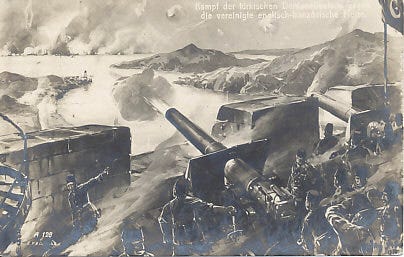
The Action of the 19 February had been, generally successful and lessons had been learned. In his history of the War at Sea (Vol 2) Julian Corbett wrote that;
On the whole the first day’s experience was promising for the success of the enterprise, it seemed clear that an hour’s more good light would have entirely finished the entrance forts, yet in one important particular the results were disappointing. Eventual success depended mainly on the superiority of the fleet in long-range armament, and the unexpected activity of Forts Helles and Orkanie at the close of the day had shown, in the Admiral’s opinion, that the effect of long-range bombardment on modern earthworks was slight.
Otto Liman von Sanders, the Commander of the Ottoman forces on the Peninsula wrote post War that;
The guns of the enemy fleet were at first directed against the old works and batteries of Seddulbar (Sedd el Bahr) and Kum Kale which closed the entry of the Dardanelles; the ships were modern heavy artillery remaining beyond the range of the older Turkish guns. The available means in this conflict were too unequal to leave the outcome in doubt. After a few bombardments the Turkish batteries were silenced and part of the fortifications destroyed.
The big issue though was that the guns were not getting knocked out unless there was a direct hit to them and the Navy’s accuracy had been somewhat lacking and the usual tactic of firing more shells than the opponent was problematic due to ammunition shortages and the age of the guns on the ships. Further to that it was deemed that firing indirectly without accurate spotting was very inefficient so they would need to fire directly and at a short range - preferably anchored.
It was not quite the resounding success and it was realised that this would be a slow but steady campaign that could be expedited by good weather and fortune and that worked out well for the planners as that meant there was time to argue for or get soldiers for the landing that many perceived to be necessary. To fill the gap Royal Marines from the Portsmouth and Deal battalions were to be sent and ten battalions of the Royal Navy Division were also brought to standby with the orders to proceed to Lemnos being prepared with an estimated date of departure being 27th February. If the Army could not provide troops then the Navy would.
Kitchener was under pressure from news from the Eastern Front with Russia being in serious trouble. Despite losses the Ottomans, Austro-Hungarians and Germans were pushing them back with Czernowitz falling and in Prussia the Russian offensive had stumbled hard and German sources claimed taking 100,000 prisoners. There were also shortages of rifles and equipment and should Russia collapse then the Germans would be able to transfer troops over to the West and resume their offensive, worse case scenario the Austrians came too! This led to the question of the XXIX Division. If they were employed quickly they could take the Dardanelles and knock Turkey out of the war but should the Germans attack in the West then the Division would be needed in France and Belgium.
Side note - the XXIX Division was formed from Regular units of the British Army who had returned to Britain from overseas garrison duties through late 1914 and were reorganised into one Division. They were the strategic reserve whilst the “New Army” was being trained.
The Australian division (Including my Great Grandfather) were readied in Egypt and with the Ottoman threat to the Suez diminished, for the moment, could be sent. Despite some of these troops having taken part in operations in Neu Guinea and Samoa the majority of the Australian troops were untried in battle and inexperienced - the same with the Naval Divisions but they were better than nothing. There would also be around 15,000 French troops attached to the force and even talk of Russia attacking Constantinople from the East with 10,000 men and their Black Sea Fleet.
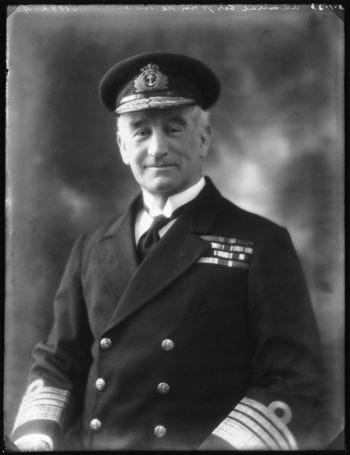
The Admiralty were keen to point out having all of these troops was one thing but the logistics of transporting them, their supplies, horses, guns and keeping them resupplied would require a lot of ships that, at the current moment they didn’t have. With Kitchener holding off on sending the XXIXth Division it gave the Admiralty time to requisition ships and send them to Alexandria and also for the Naval Division and Australian & New Zealand forces to ready themselves.
Whilst London was trying to tackle these issues Admiral Carden was tackling his own in the form of bad weather.
The hope to go in the next morning and to capitalise on the success of the 19th, Carden was going to attack the next day but bad weather and a gail set in over the next two days and it wasn’t until the 22nd that Carden was able to telegraph his intention to go into action on the following morning. So why not go into action on the 22nd?
Gale blowing in forenoon so we anchored under lee of Tenedos. Agamaemnon coaled 845 tons. Damned awful sweat. - H Williams HMS Agamemnon.
With the light situation being only good enough between 10 a.m. and 5 p.m. even losing the morning would not have enough time to fulfill all of the objectives in the mouth and up into the Narrows.
The weather continued to not play ball for the Allied Navy solidifying the thought in Carden’s mind that a landed force of soldiers could have completed the task whilst his ships were impotently bobbing around in the storm. To this end Kitchener had already instructed the Australians to be ready for deployment mid-March and the Admiralty sent the transports they had been storing to Alexandria with orders for embarkation on 27th February. Carden hoped that if they could land the Australians quickly they could advance and hold the outer forts to stop their reoccupation which would at least give the navy a toe hold and they could start attacking the intermediate forts without concern or having to go past the, possibly reinhabited, forts every time nor give the Ottomans time to repair and resite the guns and defences.
There is more to the story of what the army were doing but it is a bit beyond my scope of what the Senior Service were doing so I’ll only cover it in bits and pieces here. Ultimately the Navy only wanted around 100,000 men to hold the peninsula objectives to let them pass and to take and hold Constantinople, something Duckworth had lacked in 1805, and the numbers were in their favour as long as London and Paris agreed. There was a disagreement about landing a whole force but it was accepted Demolition parties or Marines would be allowed and on the 24th February Marines of the Chatham and Plymouth battalions had arrived under General Trotman, their orders were to only spike the guns as a priority and if time allowed to blow the main magazines at the forts but at apace.
Although the weather was somewhat better on the 25 February it was still bad enough to stop the seaplanes from being launched to give feedback on the attack or to spot for the warships.
The objectives were straightforward.
First they had to complete the destruction of the Outer forts and positions that they had begun on the previous attempt but at close range with two sets of battleships working in pairs engaging Helles and Orkanie with secondary guns at 8000 yards. All the while the minesweeper swept the mouth of the Straits. The key to the order was to aim for the guns and try to knock them out with a direct hit.
Vengeance (under de Robeck) would go in with the Cornwallis whilst Admiral Guepratte aboard Suffren with Charlemagne formed the other pair. Bringing up the rear would be the Agamemnon, Irresistible, Gaulois and crucially the Queen Elizabeth whose big guns would be of great assistance. The rearguard were to fire on all forts to make sure any guns in them would not be used against the attacking forces. Agamemnon and Irresistible were going to survey the enemy’s fire and forts that were being shelled.
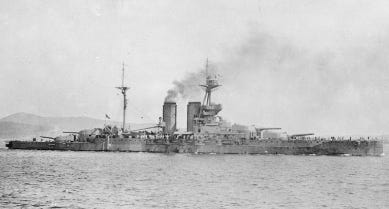
The Queen Elizabeth was anchored about 11,600 yards southwest of Helles lighthouse whilst the light cruiser Dublin stood off Demetrios Point to spot for the Super-Dreadnought. To the north of the Queen Elizabeth the Inflexible (with Carden aboard) whilst Agamemnon was between the Queen Elizabeth and Cape Yeni Shehr.
The big guns of Queen Elizabeth roared for the first time in the campaign at 10:15 a.m. on Rumeli Hamidiye Tabyasi on the European side of the strait whilst the Gaulois engaged Kumkale (Fort 6) but the Ottomans did not sit idle and returned fire.
…after half an hour I record that at 10:36 Fort fired 100 yards short. At 10:38 Fort fired and hit us amidships on main derrick-head, passing through the funnel and killed three men - Leading Seaman Small and Ordinary Seaman Mason and P.O. Worthington - and wounding very badly Yeoman Bishop, Gunner White, etc., nine altogether.
Meanwhile, as our after turret was not closed up (only the Stab. ‘nine-twos being fired) I was strolling round recording the enemy shots falling. The Commander was trying to get the disengaged side painted, but the men were not very willing and I cannot really blame them. Seeing shells falling all round us the flagship signalled us to weigh )anchor) - H. M Denham HMS Agamemnon.
Fort Helles, which they presumed was out of action, was in fact still fully functioning with her two 9.4” guns straddling the pre-dreadnought and Carden ordered her to begin to move away but the shells kept pouring in and seven shells stuck her causing a hole above the waterline, severely damaging the main derrick leaving it with a broken head casting and shrapnel raining down on the crew as well as damaging the hydraulic motor. Acting Chief Yeoman A. A. Bishop, as mentioned by Denham, was wounded, his leg was shattered but he stayed at his post passing signals from the fore top to the bridge and gunners.
At this moment we had everyone below deck; but now we had to get up the cable-workers, and so I thought I would go up and see the anchor weighed; however. no sooner had I got to the fore screen-door, than a large shell landed in the oilskin locker and burst right over me, sending lumps of iron splinters all over the shop. I saw red for about two seconds and got a bit of a blast which knocked down most of the men behind me wounding many. whom I could hear groaning a few seconds later. Lumps of stuff were falling all around me but only one small bit hit me on the hand; only just penetrating the skin; it made me dash for the mess deck to get under cover. - H. M. Denham HMS Agamemnon.
Even as Agamemnon weighed anchor and attempted to move away from the enemy’s guns she continued to take damage with Denham recording that;
While we were weighing, shots fell just over and then just short twice respectively, as we started going ahead and astern alternately with the engine. We were. however hit five times during this evolution. Next hit was on S 2 turret on the side armour this shell then went right through the upper deck, bursting in doing so and sending splinters everywhere around penetrating all our plating, light circuits, etc,. but hitting no one, and it eventually landed in the Marine’s barracks. The third hit went through the foremost funnel and burst on the port foremost winch, smashing it to pieces and holding the flying deck. Fourth shot hit the top gallant mast 3 yds above the foretop, but only just scraped the outer wood off. Number 5 shot was an armour piercing shell which holed the side on the aft deck in the ship’s office, passed through two cabins, through main deck in the after hydraulic room causing a fire in a dangerous place, being between two magazines; however it was soon extinguished. Number 6 hit the 9-in belt abreast of S 3 turret and failed to penetrate it.
At 10:45 we broke away and steamed out of range, but they still went on firing at us very close each time but never hitting again for we were soon beyond their range. We had been firing one gun per minute with our starboard battery.
The Queen Elizabeth trained her guns on Helles to avenge the damaged Agamemnon and her heavy shells began to rain down whilst the fort targeted the Dublin. Even with shells from the fort straddling his cruiser and a field gun operating on the headland, Captain John Kelly did not flinch and returned fire and continued to spot until Carden spotted the peril she was in and ordered Inflexible to take Dublin’s place on the line.
I may have misled you a bit with that last paragraph, the Queen Elizabeth’s guns certainly roared and shells hammered overhead, however the ship’s guns and gun crew were untested and it took over an hour and sixteen salvoes before they started to hit the fort with direct hits though one did knock a 9.4” gun out of action.
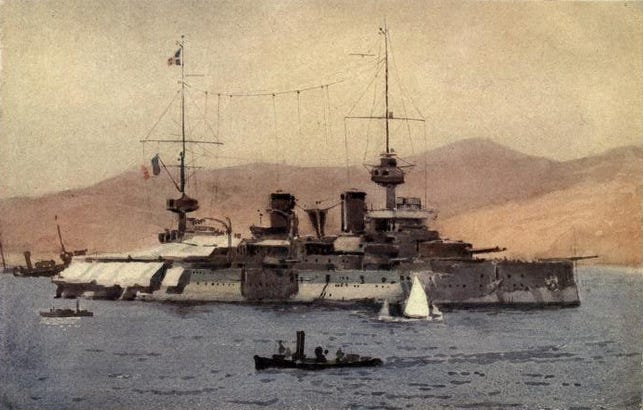
The French were also causing havoc for the defenders with the Gaulois attacking Kumkale from her anchored position off the Asiatic shore with Bouvet four miles northwest of Helles carrying out her spotting role. Unfortunately for the French flagship she began to draw attention from Helles and she was straddled by enemy fire. The French gunners soon began to fire so heavily on the enemy that they were able to slip away unmolested. By 11:00 a.m. she was at 10,000 yards and at 11:30, once Helles was being struck, or almost struck, by the Queen Elizabeth and her gunners running for cover from 15” shells, the French ship returned to targeting Kumkale.
The Queen Elizabeth engaged Fort 3 and then Fort 1, which the Agamemnon also tackled, and we watched, from where we lay-to at about 14,000 yards off, the firing of the Queen Elizabeth at 15,000 yards. The 1950 pound shell bursting was appalling. As each exploded it seemed as if some vast crater had been set in eruption. The accuracy was excellent, and time after time the shells fell on the fort. Without doubt one of the big guns was knocked out in Fort !.
And with this titanic hammering there was no sound. That struck one as the most curious feature of the whole spectacle. There was no sound. With the wind blowing straight off the land we could not hear anything. - Stewart & Peshall HMS Cornwallis
Whilst this was going on the Irresistible began her attack on Orkanie with the wounded Agamemnon spotting for her. The Chatham ship soon got the range of the target and between 10:27-55 she poured fire upon the earthworks keeping the gunner’s heads down and by midday there was no fire being levelled at the Allied ships.
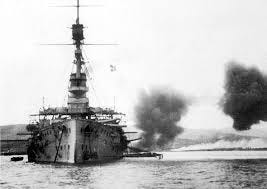
Vengeance and Cornwallis were signalled to carry out their first run;
At midday the Vengeance led the Cornwallis for the first close in run at twelve knots, and taking station at half a mile, we opened at 6,000 yards, and fairly poured it in on Forts 4 and 1 in salvoes of 12 and 6-inch. All the time Fort 6 at Kum Kale fired at both ships.
A shot from our fore-turret capsized one gun in Fort 4, and later on we put a beauty on a gun in Number 1. The 6-inch salvoes fell in bunches all round the embrasures, and during the run, which lasted about twenty-five minutes, we fired one hundred and forty rounds of 12 and 6-inch. Two shots passed us very close. One just missed the bow, and the other, close to the foretop, fell over. -Stewart and Peshall HMS Cornwallis.
De Robenck led both ships in with Vengeance leading and at 1:00 p.m. they fired on both Orkanie and Helles as well as Kumkale and Sedd el Bahr as they got closer with Cornwallis covering Vengeance when she turned away near Kumkale. The Ottomans fired a few scattered guns, one from each fort and some field guns but neither ship was seriously damaged.
With the firing abating at around 1:22 p.m. the covering ships had a look to see what damage had been done with reports that although both Helles and Orgkanie had been hit there was still a gun visible and one not at Helles, the battery wasn’t manned but guns were still there, Sedd el Bahr had three guns were still visible.
A second run was authorised and the Sedd el Bahr, Orkanie and Kumkale came under fire again at a closer range with the Suffren firing on Orkanie at 2:10 p.m. from 9000 yards for fifteen minutes with the defenders not firing but the Agamemnon reported that the French were firing too far to the right of the battery. By 2:40 p.m. the Suffren turned to Kumkale pushing the fire to 3000 yards before heading for Sedd el Bahr. The Charlemagne turned and kept up fire on Kumkale and only one shot was fired at her from the fort.
By 3:00 p.m., with the guns silenced, the minesweepers went in under the cover of destroyers, Albion and Triumph patrolling the thoughts. The Albion on the south shore and Triumph on the north shore. The battleships moved to two thousand yards and fired with both turrets and secondary armament and after a brief duel with a lone gun at Orkanie there was little in the return of resistance. From what they could tell Helles had had all of its guns dismounted and the main resistance came from field guns scattered around the peninsula.
At 4:00 p.m. the battleships withdrew leaving the sweepers under the cover of Vengeance, Albion and Triumph.
The outlook was considered “An excellent day” by Guepratte.
According to post War analysis by the Ottomans the guns at Kumkale and Sedd el Bahr were knocked out, one at Orkanie smashed and the rest out of action and Helles had both guns disabled.
The first set of objectives had been achieved and the mouth of the straits neutralised but there were issues.
When the return of ammunition was made, exception was taken by the flagship to the amount expended by the Cornwallis. That was but one of our stumbling-blocks-limited am-munition. The country knows this by now. It is no secret. But in the early days of the immortal gamble the lesson had not been learned that without unstinted ammunition ships are unable to do damage, just as infantry attacks are futile without unlimited artillery preparation.
The Turk sticks to his guns, and it is necessary to land a shell on the gun itself. Many shells go close and on earthworks do little or no harm at all. - Stewart & Peshall HMS Cornwallis
The Navy were still finding that the amount of ammunition spent was not equalling decimation of the guns and indeed resistance resulting in damage. A new approach might have to be looked at…