
Just following orders...

In another thinly veiled political post…
At the end of the Second World War there was a common response from Wehrmacht and SS officers that they could not be held accountable for their actions because they “Were just following orders” and that the senior officers should be to blame for giving the order and not them for pulling the trigger.
To a certain degree this was a cultural defence as the Prussian school of militarism stated that when an order was issued it was to be obeyed and not questioned. Armies are run on discipline and structure and if every Unteroffizier were to question an order or the plans of the superior (militarily and often socially) then nothing would get done. By the Second World War this was still very much an existent process - hence the confused faces at Nuremberg.
There was even a term for it - Befehlsnotstand - literally “Necessity to obey orders” which was aimed at all soldiers doing what they were told and it was part of the Military law framework.
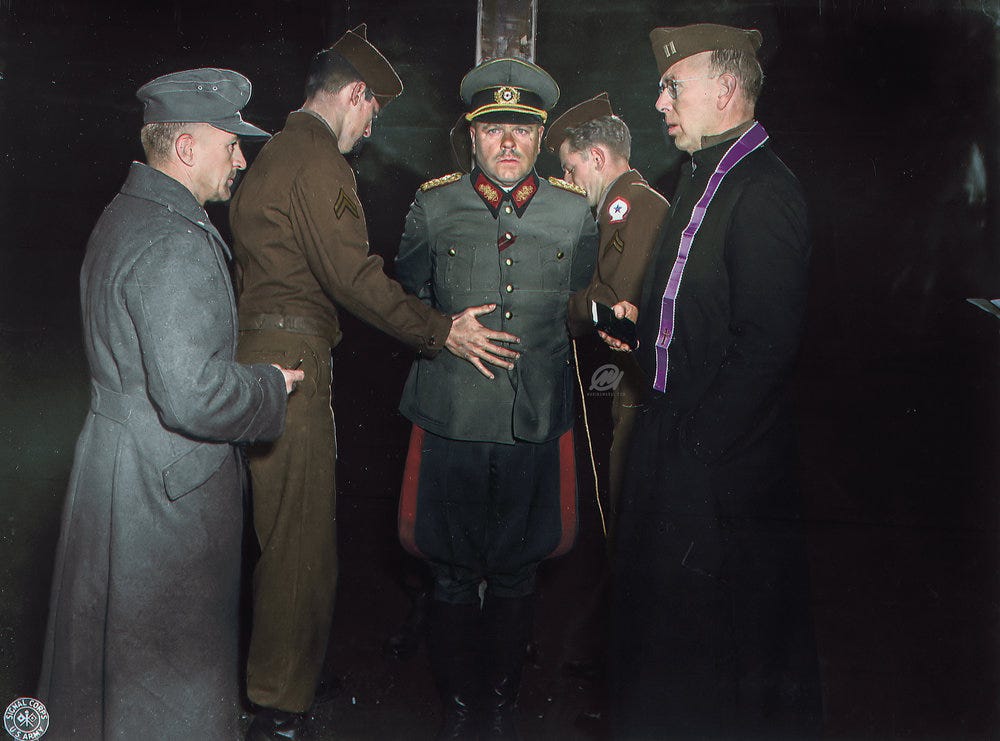
One example is the trial and execution of General Anton Dostler.
When a group of American Commandos was captured in Italy, in March 1944, their interrogation revealed they were on a sabotage mission and the commanding officer, Colonel Almers of the 135th (Fortress) Brigade contacted his Army Corp Commander, General der Infantrie Dostler who duly passed the query up to Feldmarschall Albert Kesselring the theatre commander.
Kesselring didn’t need to think about it, the instructions from the Fuhrer were clear as crystal.
Commandos were to be treated as spies and to be executed, without trial, despite their wearing uniform and, by rights, should be held as P.O.Ws.
Kesselring passed the message down to Dostler who ordered Almers to carry out the sentence without question. Afterall, it was a direct order.
Almers hesitated. He didn’t like the order and felt that it was an unjust order and he questioned his superior on three separate occasions but the answer was always the same and on the 26 March, 12 days after their capture, the men were shot by Firing squad and buried in a mass grave.
At the end of the War Dostler found himself before an American tribunal for War crimes and the murder of the fifteen OSS men.
His defence?
Following superior orders.
Kesselring had given the order, Almers had carried out the order, he was just the conduit. The Tribunal did not agree and argued that a General Officer had every right to question the order and refuse to carry it out as his subordinate had done.
Dostler was taken out and shot on 1 December 1945 and in the photograph of his execution (above) he does have a somewhat confused and stunned expression rather than an arrogant defiance.
What was the alternative? Surely in the German Army and NSDAP state failure to obey an order would lead to your own death?
Yes, this is the case at times.
Feldwebel Anton Schmid was shot on 15 April 1942 in Vilnius for aiding and abetting “Enemies of the State”. He had started off by being lenient towards German soldiers who were found separated from their units recognising shell shock and combat fatigue from his First World War Service and fudging the paperwork so they would not appear as deserters and face the firing squads. One of the men was a Polish Jew who was trying to escape liquidation and Schmid gave him a deceased soldier’s paybook and gave him a job as a typist. Through 1941 and into 1942 he utilised permits to hire Jews and Soviet P.O.Ws for his offices and even used Wehrmacht trucks to shift them to safer areas of the front away from liquidation.
Crucially he was also introduced to members of the Jewish resistance forces and moved some of their unarmed number to Grodno as vital Jewish workers. He was denounced and later shot firmly believing that;
We all must die. But if I can choose whether to die as a murderer or a helper, I choose death as a helper.
Joseph Schultz, a young soldier in the Wehrmacht, refused to take part in a firing squad targeting Yugoslavian “Partisans” as there were children among the prisoners. His refusal to shoot the civilians saw him put against the wall as well.
However, there are plenty of examples where illegal orders were refused or duties declined with no consequence.
Interestingly members of the Einsatzgruppen, who were usually civilian police men and reservists, could refuse to carry out the mass killings of the labelled “enemies of the state” and instead of punishment find themselves rotated back to Germany and other duties and replacements sent out. This wasn’t always due to a sense of morality but rather the gruesome business of murder up close and personal causing mental scarring and drunkenness which left them unable to carry out these orders.
Albert Battel, a member of the NSDAP and serving officer in the Wehrmacht was responsible for the protection of around 90 Jews in Przemysl when the SS turned up to liquidate the ghetto there. Soldiers under Battel’s command sealed the refugees in a courtyard owned by the Wehrmacht and intercepted the SS’s column and turned them away and even threatened to shoot at the SS. Battel then went into the Ghetto with Wehrmacht trucks and threatened the SS with troops if they stopped him, before taking another 100 workers and their families out of the ghetto. In total 500 people were saved from extermination.
Battel would argue that he had protected valuable workers needed for the Reich’s military production and his superiors in the Army basically gave him a slapped wrist, took his First World War Iron Cross away and moved him to another post. The SS were not so lenient and under Himmler’s personal direction a case was drawn up and at the conclusion of the war, Battel would find himself “Nacht und Nebel”.
Thankfully for him he was discharged from the military in 1944 for a heart complaint and escaped the SS. He would pass away in 1962 and was later honoured with the Righteous among the nations.
The big issues were peer pressure from the rest of the unit and or fear of denouncement to the State’s apparatus such as the SS or Gestapo and questions of loyalty to the State and or sympathies for “Enemies of the State” which, as the War went on and everyone got more fanatical, could lead to dire situations.
So what am I driving at?
Morality is a very personal thing and those that have religion, which I do not, have some very clear cut guidelines in the Ten Commandments or atheists like me have also got Roman Law.
If an order comes down from a superior officer, no matter what their rank, it is your duty to question its legality, however fleetingly, and if it is an illegal order to refuse to follow it. Should the tide turn you will not be able to hide behind the “Following orders” defence - legal precedent has overturned that.
As John Stuart Mill said;
Evil wins when good men do nothing
Oddly the Dostler case is a case in point, as it was relatively risk free for general officers to refuse orders, the worst that happened to them was forced retirement.
Unfortunately the Rules of War are selectively applied: https://www.military.com/daily-news/investigations-and-features/2026/01/05/biscari-massacre-pattons-soldiers-executed-73-axis-pows-sicily-then-army-covered-it.html?fbclid=IwdGRleAPVeBZleHRuA2FlbQIxMQBzcnRjBmFwcF9pZA8xNzM4NDc2NDI2NzAzNzAAAR6_hPC0AB00P2XMjpI0PQHvOrxKZ9sg0ru7aow3x1pDqfNrdRdWW2igk0-HrQ_aem_ipuN_DsinWOiRYObvUj8OQ
Since you’re an proclaimed atheist I tip my hat to you; you have more faith than I do.