
Alabama's last battle
In the words of her Captain

The CSS Alabama was a famous Confederate commerce raider during the American Cival War which saw action in the west and east Indies betwen her commissioning in 1862 until 24 August 1864 when she was sunk off Cherbourg by the USS Kearsarge. Her story does deserve a deep dive, probably over a few posts but as a bit of a change from the usual First and Second World Wars I thought I would share the account of the final action in the words of the Alabama’s Captain, Raphael Semmes.
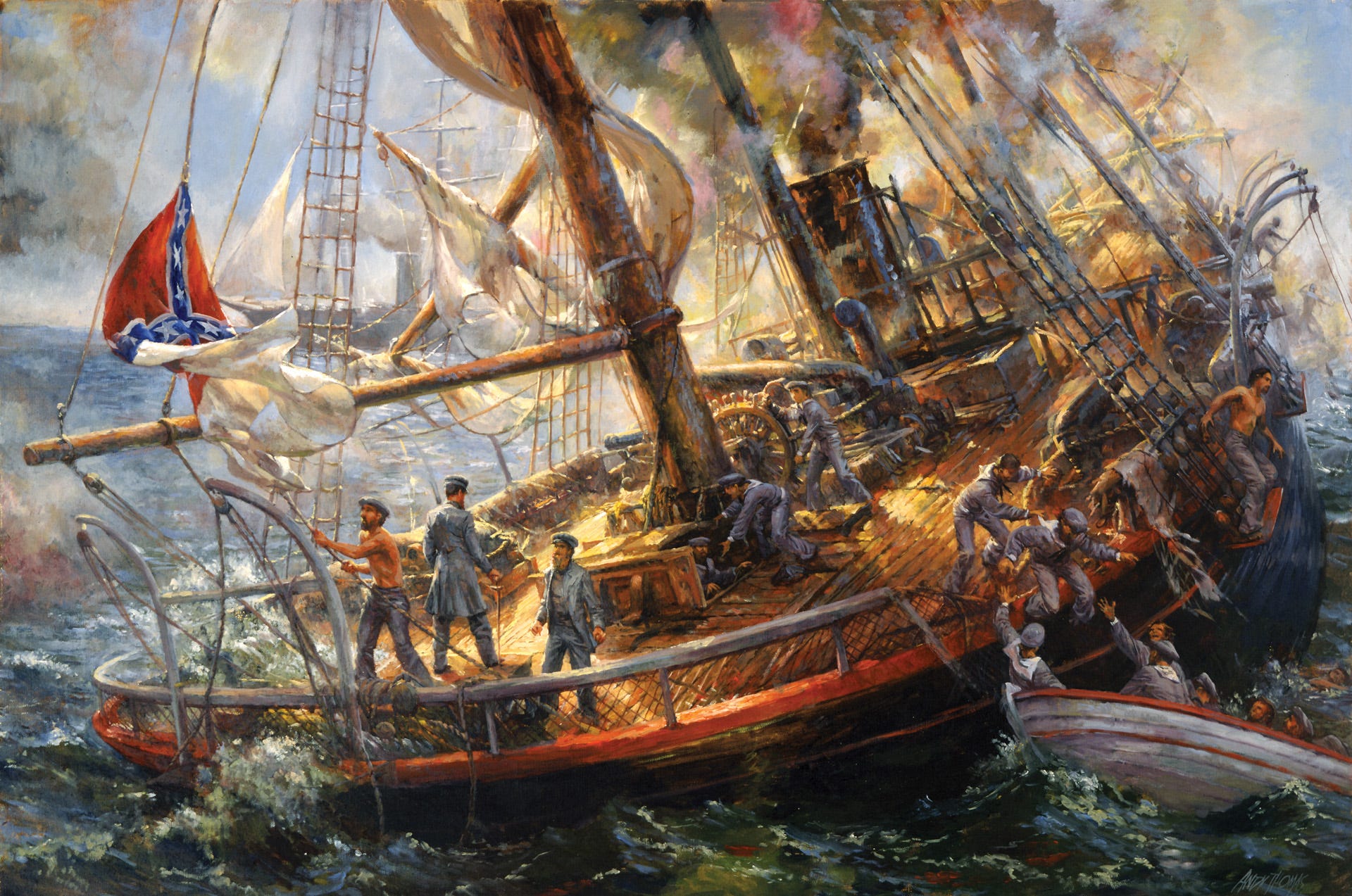
This was to be the Alabama’s last port.
She had run her career, her record had been made up and in a few days more, she would lay her bones beneath the waters of the British Channel, and be a thing of the past. I had brought back with me all my officers, except the paymaster, whom I had discharged at the island of Jamaica, as related in a formerchapter, and the young enginer, who had been accidentally killed at Saldanha Bay. Many changes had taken place, of course, among my crew, as is always the case with sailors, but still a large proportion of my old men had come back with me. These were faithful and true and took more than an ordinary interest in their ship and their flag. There were harmony and mutual confidence between officers and men. Our dicipline had been rigid but mercy had always tempered justice, and the sailors understood and appreciated this.
I had been successful with the health of my men beyond precedent. In my two ships, the Sumter and Alabama, I had had, first and last, say five hundred men under my command. The ships were small and crowded. As many as two thousand prisoners were confined, for longer or shorter periods, on board the two ships and yet, out of a total of twenty-five hundred men, Ihad lost a single man by disease. I had skilful and attentive surgeons, I gave them Carte Blanche with regard to medicines and diet, and my first lieutenant understood it to be an important part of his duty to husband the strength ofhis men.
The means which were resorted to by all these officers, for preserving the health of the crew, have been detailed. The reader has seen, not only how their clothing was changed as we changed our latitude, but how it was changed every evening, when we were in warm climates. He has seen how sedulously we guarded against intemperance, at the same time that we gave the sailor his regular allowance of grog. And last, though by no means least, he has seen how we endeavoured to promoted a cheerful and hilarious spirit among them, being present at, and encouraging them in their diversions.
Immediately upon anchoring, I sent an officer to call on the Port Admiral, and ask leave to land my prisoners from the last two ships captured. This was readily granted, and the nect day I went on shore tosee him myself, in relation to docking and repairing my ship. My arrival had of course, been telegraphed to Paris, and indeed, by this time, had been spread all over Europe. The Admiral regretted that I had not gone into Harve, or some other commercial port, where I would have foud private docks.
Cherbourg being exclussively a naval station, the docks all belonged to the government, and the government would have preferred not to dock and repair a belligerent ship. No positive objection was made, however and the matter was laid over until the Emperor could be communicated with. The Emperor was then at Biarritz, a small watering place on the south coast, and would not be back in Paris for several days. It was my intention, if I had been admitted promptly into dock, to give my crew a leave of absence for a couple of months. Thy would have been discharged, and dispersed, in the first twenty-four hours after my arrival, but fr this temporary absence of the Emperor. The combat, therefore, which ensued, may be said to be due to the Emperor’s accidental absence from Paris.
When the Alabama arrived in Cherbourg, the enemy’s steamer Kearsage was lying at Flushing. On the 14th of June, or three days after our arrival, she steamed into the harbor of Cherbourg, sent a boat on shore to communicate with the authorities, and without anchoring, steamed out again, and took her station off the breakwater. We had heard, a day or two before, of expected arrival of this ship, and it was generally understood among my crew that I intended to engage her. Her appearance, therefore produced no little exctement on board.
The object which the Kearsarge had in view, in communicating with the authorities, was to request that the prisoners I had sent on shore might be delivered up to her. To this I objected, on the ground, that it would augment her crew, which she had no right to do, in neutral waters, and especially in the face of her enemy.
Captain Winslow’s request was refused and the prisoners were not permitted to go on board of him. I now addressed a note to Mr Bonfils, our agent, requesting him to inform Captain Winslow, through the United States Consul, that if he would wait until I could receive some coal on board - my supply having been nearly exhausted, by my late cruising - I would come out and give him battle. This message was duly conveyed, and the defiance was understood to have been accepted.
We commenced coaling ship mmediately, and making som preparations for battle; as sending down all useless yards and top-hanger, examining the gun equipment, and overhauling the magazine and shell-rooms. My crew seemed not only willing, but anxious for the combat, and I had every confidence in their steadiness and drill; but they labored under one serious disadvantage. They had had but very limited opportunities of actual practice at target firing, with shot and shell.
The reason is obvious. I had no means of replenishing either shot or shell, and was obliged, therefore, to husband the store I had on hand, for actual conflict. The stories that ran the round of the Federal papers at the time, that my crew was composed mainly of trained gunners from the British practice ship Excellent, were entirely without foundation. I had on board some half dozen British seamen, who had served in ships of war in ofrmer years, but they were in no respect superior to the rest of the crew. As for the two ships, though the enemy was superior to me, both in size, stanchness of construction, and armament, they were of force so nearly equal, that I cannot be charged with rashness in having offered battle.
The Kearsage mounted seven guns:- two eleven inch Dahlgrens, four 32 pounders, and a rifled 28 poundee. The Alabama mounted eight:- one eight inch, one rifled 100-pounder, and six 32 pounders. Though the Alabama carried one gun more than her antagonist, it is seen that the battery of the latter enabled her to throw more metal at a broadside - there being a difference of three inches in the bore of the shell-guns of the two ships.
Still the disparity was not so great, but that I might hope to beat my enemy in a fair fight. But he did not show me a fair fight, for, as it afterward turned out, his ship was iron-clad. It was the same thing, as if two men were to go out to fight a duel, and one of them, unknown to the other, were to put a shirt of mail under his outer garment. The days of chivalry being past, perhaps it would be unfair to charge Captain Winslow with deceit in witholding from me the fact that he meant to wear armor in the fight. He may have reasoned that it was my duty to find it out for myself. Besides, if he had disclosed the fact to me, and so prevented the engagement, the Federal Secretary of the Navy wouldhave cut his head off to a certainty. A man who could permit a ship of war, which had surrendered, to be run off with, by her crew after they had been paroled - see the case of the Mercedita described in a former chapter - and who could contrive at the sinking of the Florida, to prevent the making of a reparation of honor to Brazil, would not be likely to be very compacent toward an officer who showed any signs of weakness on the score of honour ot honesty. Judging from the tone of the Yankee press, too, when it came afterward to describe the engagement, Winslow seemed to have gauged his countrymen correctly, when he came to the conclusion that it would not do to reveal his secret to me.
So far from having any condemnation to offer, the press, that chivalrous exponent of the opinions of a chivalrous people, was rather pleased at the “Yankee trick.” It was characteristic, “cute,” “smart.”
“Appleton’s Encylopedia of the War,” much more liberal and fair than some of its congeners, thus speaks of Winslow’s device:-
“Availing himself of an ingenous expedient for the protection of his machinery, first adopted by Admiral Faragut, in running past the rebel forts on the Mississippi in 1862, Captain Winslow had hung all his spare anchor cable over the midship section of the Kearsarge, on either side; and in order to make the addition less unsightly, the chains were boxed over with inch, deal boards, forming a sort of case, which stood out at right-angles to the side of the vessel.”
One sees a twinge of honesty in this paragraph. The boxing stood out at right-angles to the side of the ship, and therefore the Alabama ought to have seen it. But unfortunately for the Alabama, the right angles were not there. The forward and after ends of the “boxing,” went off at so fine a point, in accordance with the lines of the ship, that the telescope failed to detect the cheast. Besides, when a ship is preparing for a fight she does not care much about show. It is a fight, and not a review that she has on hand.
Hence, we have another twinge, when the paragraphist remarks that the boxing was resorted to, to make the armour appear “less unsightly!” And, then, what about the necessity for protecting the machinery at all? The machinery of all enemy’s new sloops was below the water-line. Was the Kearsarge an exception? The plain fact is, without any varnish, the Kearsarge, though as effectually protected as if she had been armored with the best of iron plates, was to all appearance a wooden ship of war. But to admit this, would spoil the eclat of the victory, and hence the effort to explain away the cheat, as far as possible.
In the way of crew, the Kearsarge had 162 all told - the Alabama, 149 I had communcated this battle to Flag-Officer Barron, my senor officer in Paris, a few days before, and that officer had generously left the matter to my own discretion. I completed my preparations on Saturday evening, the 18th of June, and notified the Port-Admiral of my intention to go out on the following morning. The next day dawned beautiful and bright. The cloudy, murky weather of some days past had cleared off, and a bright sun, a gentle breeze, and a smooth sea, were to be concomitants of the battle. Whilst I was still in my cot, the Admiral sent an officer off to say to me that the iron-clad frigate Couronne would accompany me a part of the way out, to see that the neutrality of French waters was not violated My crew had turned in early and gotten a good night’s res, and I permitted them to get their breakfasts comfortably - not turning them to unil nine O’lock - before any movement was made toward getting under way, beyond lighting the fires in the furnaces. I ought ot mention that Midshipman Sinclair, the son of Captain Terry Sinclair, of the Confederate Navy, whom I had sent with Low as his first Lieutenant in the Tuscaloosa being in Paris when we arrived, had come down on the eve of the engagement -accompanied by his father- and endeavored to rejoin me, but was prevented by the French authorities. It is opportune also to state, that in view of possible contingencies, I had directed Galt, my acting paymaster, to send on shore for safe-keeping, the funds of the hip, and complete payrolls of the crew, showing the state of the account of each officer and man.
